Origin and history
The Stabyhoun (Dutch spelling Stabijhoun, "Staby" for short) comes from the Frisian Woodlands in the east and southeast of Friesland. According to the FCI standard the name comes from "sta mij bij", stand by me, and houn is Frisian for dog. It was the dog of farmhands and small tenant farmers, not of the nobility: it kept the yard free of rats and mice, caught moles and polecats, watched the house and went along on the occasional poaching trip. It rode to the fields in a basket on the bicycle.
In the early twentieth century Stabys and Wetterhouns, the other Frisian breed, were crossed so often that both risked losing their identity. From 1938 a group from the Frisian kennel club separated them again, the Dutch kennel club recognized both breeds in 1942, and the Dutch breed club NVSW was founded in 1947. The current standard is FCI No. 222, Group 7 (continental pointing dogs, spaniel type), with a working trial. The Dutch studbook has been closed since 1968. The FCI standard links the breed to the Drentsche Patrijshond and the Heidewachtel, the old type of the Small Münsterländer.
In the US the breed is still rare. The Ameri-Can Stabyhoun Association (ASA), founded in 2006, states that the breed has been in the AKC Foundation Stock Service since 2006. It is not yet a fully recognized AKC breed.
Temperament and character
The FCI standard describes a very independent, affectionate but sometimes headstrong dog, quiet but vigilant at home and reserved at first with strangers, but never fearful. The clubs add:
- Independent by design. Farmers wanted a dog that worked without a handler. A Staby does what makes sense to it first.
- A shadow. The ASA calls them velcro dogs that follow you into the bathroom. Not a dog for long days alone.
- Alert, not protective. A Staby barks at anything unusual and then expects you to handle it.
- A hunter on its own account. Moles, mice and squirrels get chased and dug out.
- Good with children, with limits. The Dutch club calls the breed very child-friendly but warns that a Staby may signal late that it has had enough, because it is so attached to its family. Never let it get cornered, and never leave young children alone with the dog.
In its 2025 outcross plan the Dutch club voiced concern about mental instability in the breed: noise sensitivity, insecurity and stress. Ask the breeder how both parents handle thunder, fireworks and crowds.
Size and appearance
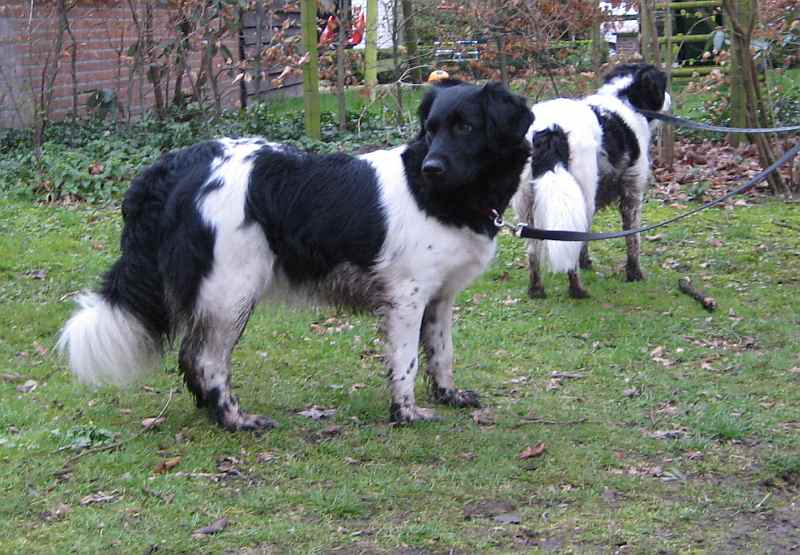
A functional, slightly long-bodied pointing dog with a medium-length straight coat and a weather-resistant undercoat. Feathering on chest, collar, trousers and tail makes it look long-haired. Colors are black or brown with white, including roans. Tan markings (tricolor) are disqualifying under the standard.
| Males | Females | |
|---|---|---|
| Height | 19.5-21 in (50-53 cm) | 19-19.5 in (48-50 cm) |
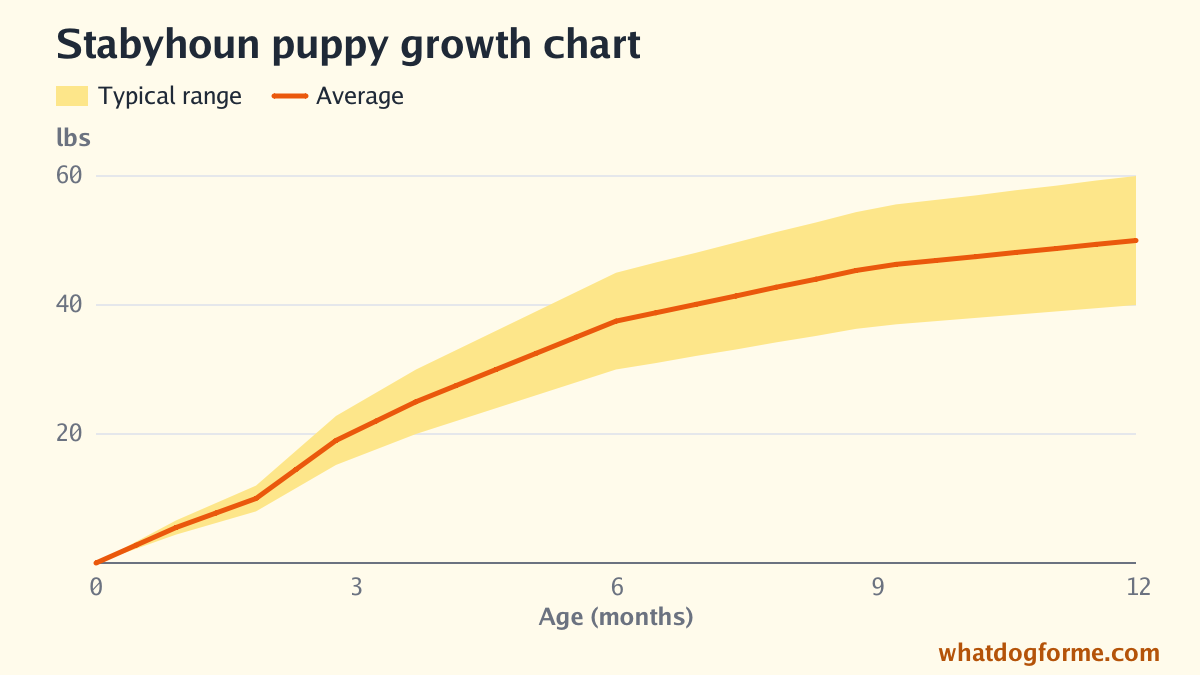
| Weight | 49-60 lbs (22-27 kg) | 40-51 lbs (18-23 kg) |
| Lifespan | about 13-14 years | about 13-14 years |
| Coat | Medium length, straight, undercoat | Same |
Height and weight are the FCI ideals; the standard allows 2 cm (about 0.75 in) either way. Royal Canin's breed profile gives the lifespan. The Dutch club's database shows that the most inbred dogs live nearly two years less on average than the least inbred.
Exercise and daily life
According to the ASA, a well-exercised Staby is a calm housemate and an under-exercised one barks and chews. The Dutch club recommends about 45 minutes of real walking a day on top of short potty trips, ideally with off-leash play with other dogs. Just as important is a job: retrieving, nosework, field training, swimming.
A house with a yard is the better fit; this is not an apartment dog. What matters most is daily exercise and not being left alone for long: the Dutch club advises not leaving an adult alone for more than four hours at a time.
Training
Stabys are smart and pick up obedience and agility easily, but they shut down under harsh handling, the ASA notes. Rewards, variety and calm consistency work.
Typical difficulties:
- A recall that loses to a mouse hole or a squirrel.
- Selective hearing when something more interesting comes up.
Grooming
Outside shedding season a weekly brushing is enough, according to the Dutch club; bathe only when the dog has really rolled in something. The ASA warns that they shed like a Lab. After spaying or neutering the coat often grows longer and mats more easily, and shedding can become year-round.
Health
The Dutch club calls the Staby relatively healthy despite its small population, but sees an average inbreeding coefficient of about 32 percent as a warning sign of health problems to come. Its 2025 outcross plan therefore aims to open the closed studbook to carefully chosen dogs of other breeds, and the club is building a breeding platform with Utrecht University. Conditions to know by name:
- Hip dysplasia. Found in 3.5 to 7.8 percent of dogs X-rayed in 2021-2024, rarely with clinical signs.
- Elbow dysplasia. 3.5 to 5.8 percent of exams; these dogs are often lame and usually need surgery.
- Epilepsy. 1.5 percent of puppies born 2011-2021. The outcross plan says the rate in dogs should ideally stay below about 0.5 to 0.7 percent and calls the Staby's rate slightly elevated. The inherited form usually starts around age three.
- Patent ductus arteriosus (PDA). A heart defect heard as a loud murmur at the 6-7 week puppy check. Two to three cases a year; with timely surgery the outlook is excellent.
- Cerebral dysfunction. An inherited, fatal disorder of young puppies, not seen since DNA testing became mandatory for breeding.
- Von Willebrand disease type I. About a quarter of Stabys are clear, half carriers and a quarter affected. Affected dogs can bleed more during surgery.
- Less often: steroid-responsive meningitis-arteritis (SRMA).
Ask to see for both parents: hip and elbow results (OFA or the European equivalent), the cerebral dysfunction DNA result, and whether epilepsy or PDA occurred in the family. A vWD DNA test is optional but worth knowing before any surgery. ASA breeding dogs also need a temperament evaluation.
Cost
Expect to pay $3,500 to $4,500 for a puppy; the ASA lists its current price at $4,000, the same in the US and Canada. Litters in North America are rare, the typical wait is about a year, and about half of each litter goes to homes that keep the dog intact for the breeding program. The club does not advertise puppies, so an ad for a "purebred Stabyhoun" is most likely a mix or an unpedigreed dog.
Running costs are roughly $1,000 to $1,600 a year: food for a 40-60 lb dog, routine vet care, preventives, insurance and training classes.
Who it suits and who it does not
Good match for:
- Families who want a calm, affectionate dog and spend time outdoors every day
- People who enjoy training, nosework, retrieving or hunting with their dog
- Patient owners who can handle an independent mind without force
- Buyers willing to wait a year for a club puppy
Not a match for:
- Long workdays with the dog home alone
- People who want instant obedience or a strict, harsh training style
- Proud gardeners and homes with free-roaming small pets
- Hunters who want a full-season gundog
For hunting all season, a German Wirehaired Pointer is built for the job. If you want a smaller Dutch breed with the same careful breeding culture, look at the Kooikerhondje.