Origin and history
The Patterdale Terrier comes from the fells of the Lake District in northern England and takes its name from the village of Patterdale near Ullswater. It was bred for work, not for the show ring. The UKC standard says it descends mainly from the black, smooth-coated Fell Terrier, a hardy dog used to control foxes and other vermin that preyed on sheep. It was bred "to bolt the quarry out of the den or to dispatch it if it chose to fight", and breeders selected for courage and a chest small enough to follow a fox underground.
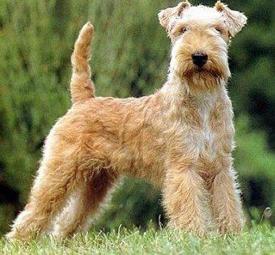
Breed histories credit huntsmen such as Joe Bowman, Cyril Breay and Frank Buck with shaping the working lines. Names were loose for a long time: Britannica notes that the Lakeland Terrier from the same region was once also called the Patterdale terrier.
Today the Patterdale is a breed only in the US. Neither the UK Kennel Club nor the FCI recognizes it, and Purina's UK breed profile says that in Britain it is "a type rather than a breed". The Patterdale Terrier Club of America (PTCA), founded in 1993, kept the first registry. The United Kennel Club (UKC) recognized the breed on January 1, 1995, in its Terrier Group; its standard was last revised on December 1, 2014. The AKC does not recognize the Patterdale, so in the US "papers" mean UKC or PTCA registration.
Temperament and character
The UKC standard calls it "an extremely courageous working terrier" that is "extremely willing to work" and has "a high desire to please". It should be peaceful with people, livestock and other dogs, but the standard is blunt: Patterdales "are not a dog for the average pet owner" and need "an owner with a sense of humor" who can tolerate "a real terrier temperament". In daily life:
- It is not a toddler's dog. Purina rates it only 1 out of 5 as a family dog and says it has a low tolerance for typical small-child behavior.
- Small pets are prey. Purina also gives it 1 out of 5 with other pets. Never trust it with rabbits or guinea pigs. Agria, a UK pet insurer, adds that it can be aggressive toward unfamiliar dogs without early socialization.
- It barks. Purina calls it "chatty": it alerts you to visitors and unusual sounds, and Agria notes it can sometimes be wary of strangers.
Size and appearance
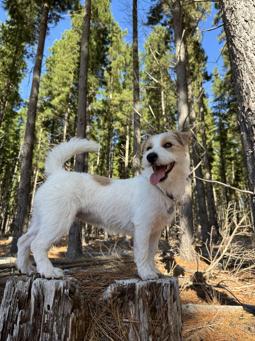
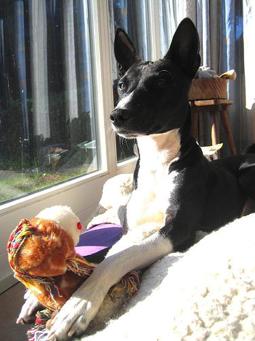
A compact, tough little terrier, square or slightly longer than tall, with small triangular ears folding just above the skull. The most important feature is the chest: the UKC requires that an average man's hands can span it directly behind the shoulders, and that it compresses when gently squeezed. The coat may be smooth, broken or rough, always with a short, dense undercoat. Allowed colors are black, red, liver/chocolate, grizzle, black and tan, and bronze, solid or with a little white on the chest and feet.
| Patterdale Terrier | |
|---|---|
| Height | 10-15 in (25-38 cm), UKC and PTCA |
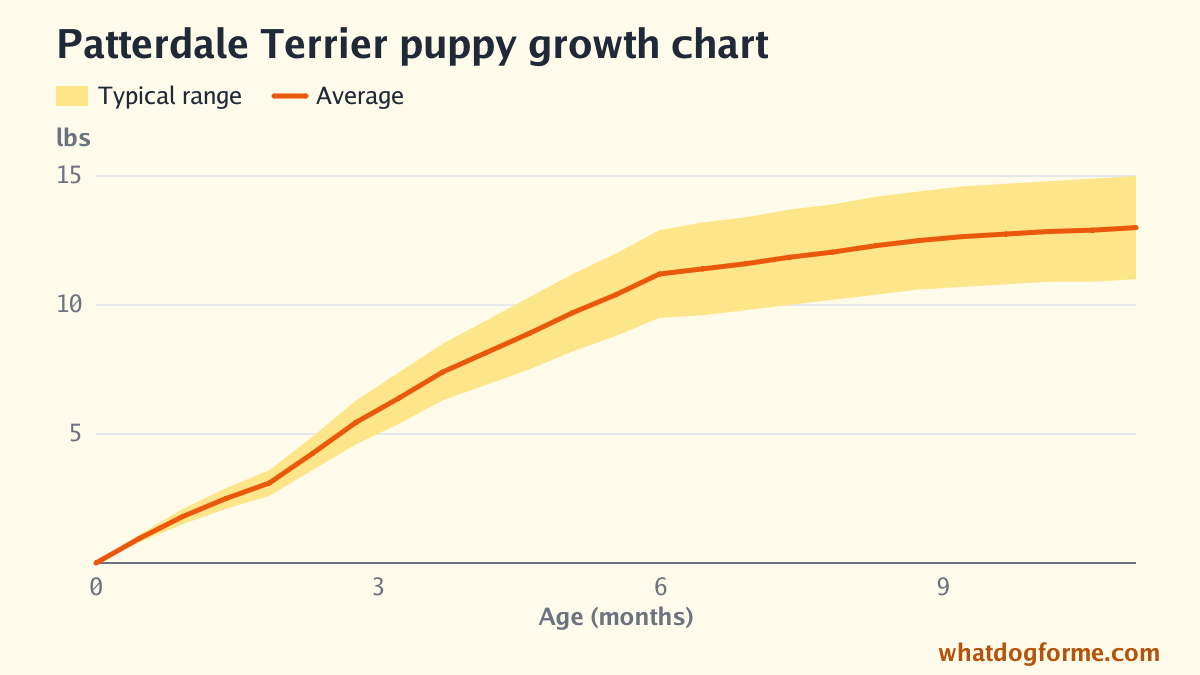
| Weight | in proportion to height; about 11-15 lbs (5-7 kg, Agria; Purina UK: 5-6 kg) |
| Lifespan | about 11-14 years |
| Coat | smooth, broken or rough |
Working scars are "considered honorable" and not penalized. If the tail is docked, only a quarter to a third may be removed, "as sometimes the tail is the only means of pulling the dog out of a burrow"; the UKC has no preference between docked and natural tails.
Exercise and daily life
Purina recommends one to two hours of walking a day and warns that walks on their own rarely meet the breed's needs: it also needs hunting-style games and training. Agria recommends at least an hour of vigorous exercise a day, and more is better. Good outlets are scent games, agility and barn hunt.
Purina says the Patterdale suits rural or semi-rural homes better than a city and needs a secure yard, because it digs, climbs and jumps. Off-leash walks near wildlife are a risk: a terrier bred to go to ground will follow a scent into a burrow and may not come out on cue. It can live in an apartment only with a lot of daily exercise, and it does not like being left alone for long.
Training
Purina rates it only 1 out of 5 for ease of training: its prey drive always competes with your voice. Train with food and play in short sessions, and stay consistent. Harsh handling makes a tough terrier tougher, not more obedient.
Typical difficulties:
- Recall. Practice from puppyhood and use a long line in open country.
- Other dogs and digging. Avoid dog parks full of strangers, and give it a digging spot of its own.
Grooming
Easy. The UKC says "very little grooming is required to keep the coat healthy". Purina recommends brushing a smooth coat once or twice a week; broken and rough coats benefit from hand stripping now and then. Shedding is moderate (Purina: 2 out of 5), and it is not hypoallergenic. After rough walks, check for cuts, thorns and ticks.
Health
No large health study, VetCompass included, reports the Patterdale separately. What the sources name:
- Primary lens luxation (PLL). The lens slips out of place, which is painful and can lead to blindness. Purina names it for the breed, and a 2011 study in Veterinary Ophthalmology (Gould and colleagues) found affected Patterdales carrying two copies of the ADAMTS17 mutation that also causes PLL in Jack Russells. There is a DNA test.
- Patellar luxation (slipping kneecap), named by Purina, Agria and Chewy.
- Skin and ear problems. In Agria's UK claims data, the top claims for Patterdales were allergic skin disorders, forelimb conditions, ear inflammation (otitis externa) and itching.
- Weight gain and dental disease. Agria warns of obesity because of hearty appetites, and Chewy lists periodontal disease.
Cost
Prices vary a lot because there are few breeders and many unregistered litters. Lancaster Puppies, a US listing site, quotes $1,000 to $2,500 for a puppy from a reputable breeder, while an older PetCalculator survey of 24 listings found $300 to $1,200, most around $500 to $700. A realistic middle is roughly $800 to $1,500; ask what that buys you, such as UKC or PTCA registration and a PLL test of both parents. If there is no breeder near you, add shipping or a flight. In the UK, Pets4Homes puts puppies at about £300 to £700.
Running costs are about $800 to $1,400 a year for food, routine vet care and preventives; pet insurance comes on top. Grooming costs almost nothing, but budget for a solid, dig-proof fence and training classes. Most states require a rabies vaccination and many cities a dog license.
Patterdale or Jack Russell?
- Color. The Patterdale is black, red, chocolate, grizzle, black and tan or bronze, with little or no white (UKC); a Jack Russell must be mostly white (FCI and AKC standards).
- Temperament. Purina rates the Patterdale 1 out of 5 for family life, ease of training and other pets, against 5, 4 and 4 for the Jack Russell. The Patterdale is the tougher working terrier of the two. For energy, Purina gives the Border Terrier 4 out of 5, against 5 for the Jack Russell and the Patterdale.
- Papers. The Jack Russell (AKC: Russell Terrier) and the Border Terrier are AKC breeds with parent clubs.
Who it suits and who it does not
Good match for:
- Experienced terrier owners who enjoy a tough, independent dog
- People who want an easy-care coat
Not a match for:
- First-time owners and families with toddlers
- Homes with rabbits, rodents, birds or cats it did not grow up with
- People who want a calmer terrier. Try the Border Terrier; for a registered working terrier of similar size, the Jack Russell Terrier; for an American farm terrier, the Rat Terrier; for a taller relative, the Fox Terrier.