Origin and history
The Rat Terrier is an American farm dog. Its ancestors were the small working terriers and feists that British miners and other immigrants brought to the US in the 1800s. The UKC lists the likely mix: Smooth Fox Terrier, Manchester Terrier and the now-extinct white English Terrier, with Whippet or Italian Greyhound blood added later for speed and Beagle for nose. The result was an all-purpose dog that cleared barns of rats, hunted small game, guarded the henhouse and played with the kids. Rat Terriers were a common sight on family farms in the 1920s and 1930s and became scarce once farms modernized.
The name is often credited to Theodore Roosevelt, who owned a feist named Skip. The AKC says the name is only "said to be coined" by him, so treat that as a good story rather than a record. What is documented is how many dogs grew out of this one farm type. The short-legged "Type B" dogs were split off in the 1990s and became the Teddy Roosevelt Terrier, which the AKC has kept in its Foundation Stock Service since 2016. A hairless puppy born to Rat Terrier parents in Trout, Louisiana, in 1972 started the American Hairless Terrier. And the Decker, a larger hunting line usually credited to breeder Milton Decker, is still sold as a "Decker Rat Terrier" or "Decker Giant", though it is not a separate AKC variety.
The Rat Terrier Club of America (RTCA) took shape in 1993. The UKC recognized the breed on January 1, 1999. The AKC took it into the Foundation Stock Service in 2004, opened companion events in 2006 and the Miscellaneous Class in 2010, and made it a fully recognized member of the Terrier Group in 2013, its 178th breed. It ranked 84th in AKC registrations in 2025. The FCI does not recognize the Rat Terrier, so it is rare in Europe.
Temperament and character
The AKC standard describes a dog that is "keenly observant, devoted, full of energy, yet easily trained and obedient to command". The AKC breed profile calls Rat Terriers "happy-go-lucky, playful, and portable companions" and "one of the calmest of the terrier breeds", but still high-energy dogs. In daily life:
- It is close to its family. The AKC rates it 5 out of 5 for affection and with young children. Most are patient with kids and want to be part of everything.
- It is a working terrier. It was bred to kill rats, and the AKC warns that most cannot resist chasing a strange cat or squirrel. Hamsters, rats and pet birds are prey.
- It usually gets along with dogs. The standard calls it a "non-sparring breed" that is generally friendly with other dogs. The AKC adds that it does best with dogs its own size or bigger.
- It may be reserved with strangers. That is in the standard too. It makes a good watchdog (AKC: 4 out of 5) and barks "occasionally", not nonstop.
With good socialization, it is one of the easiest terriers to live with. Without exercise and a job, it finds its own: digging, chasing and barking at the window.
Size and appearance
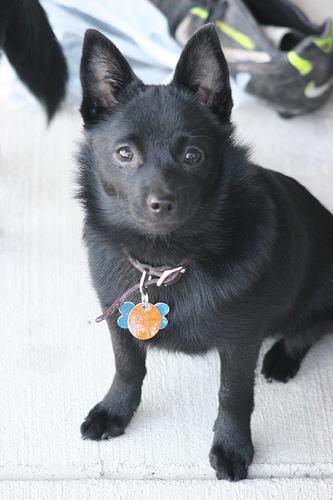
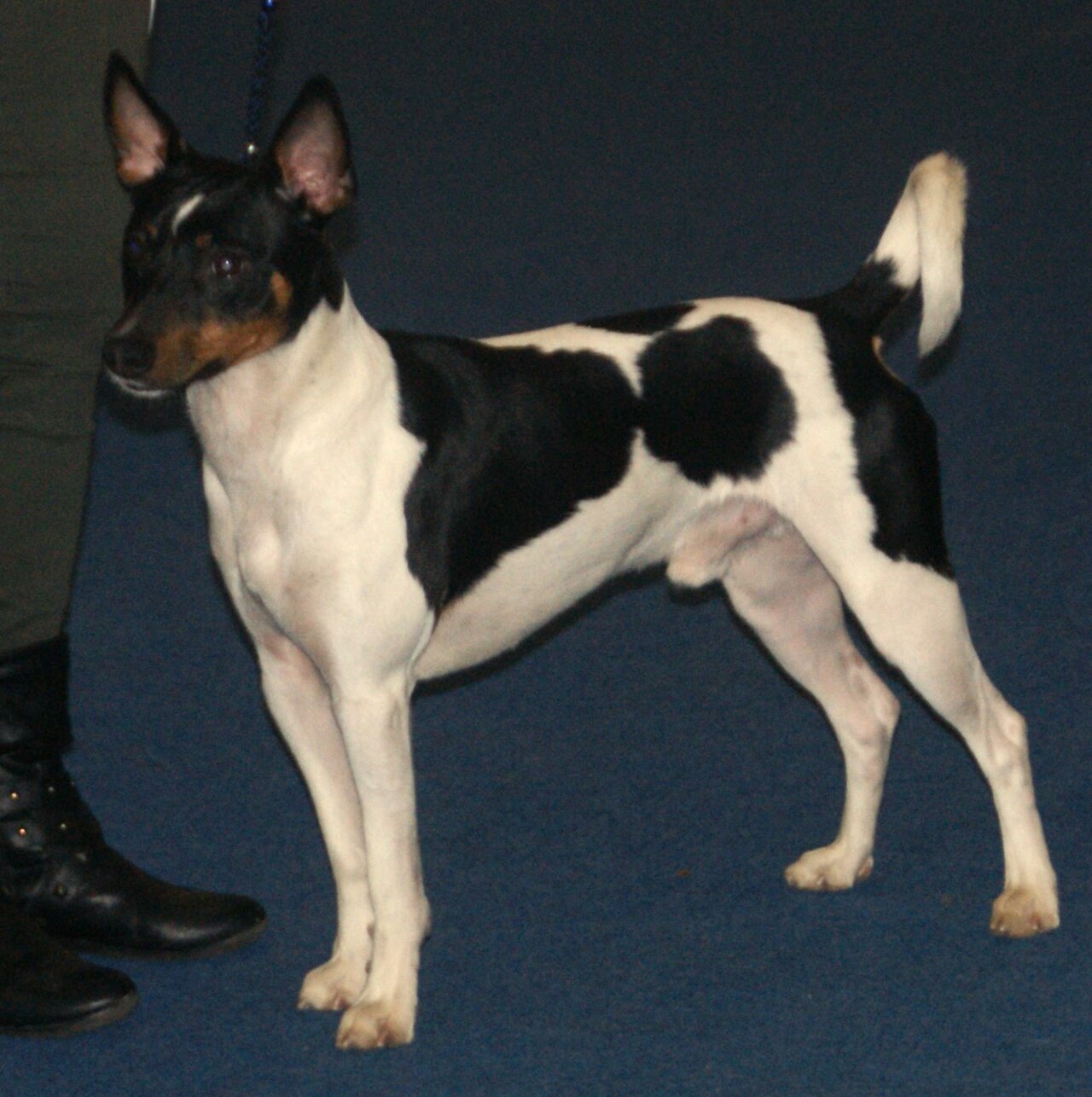
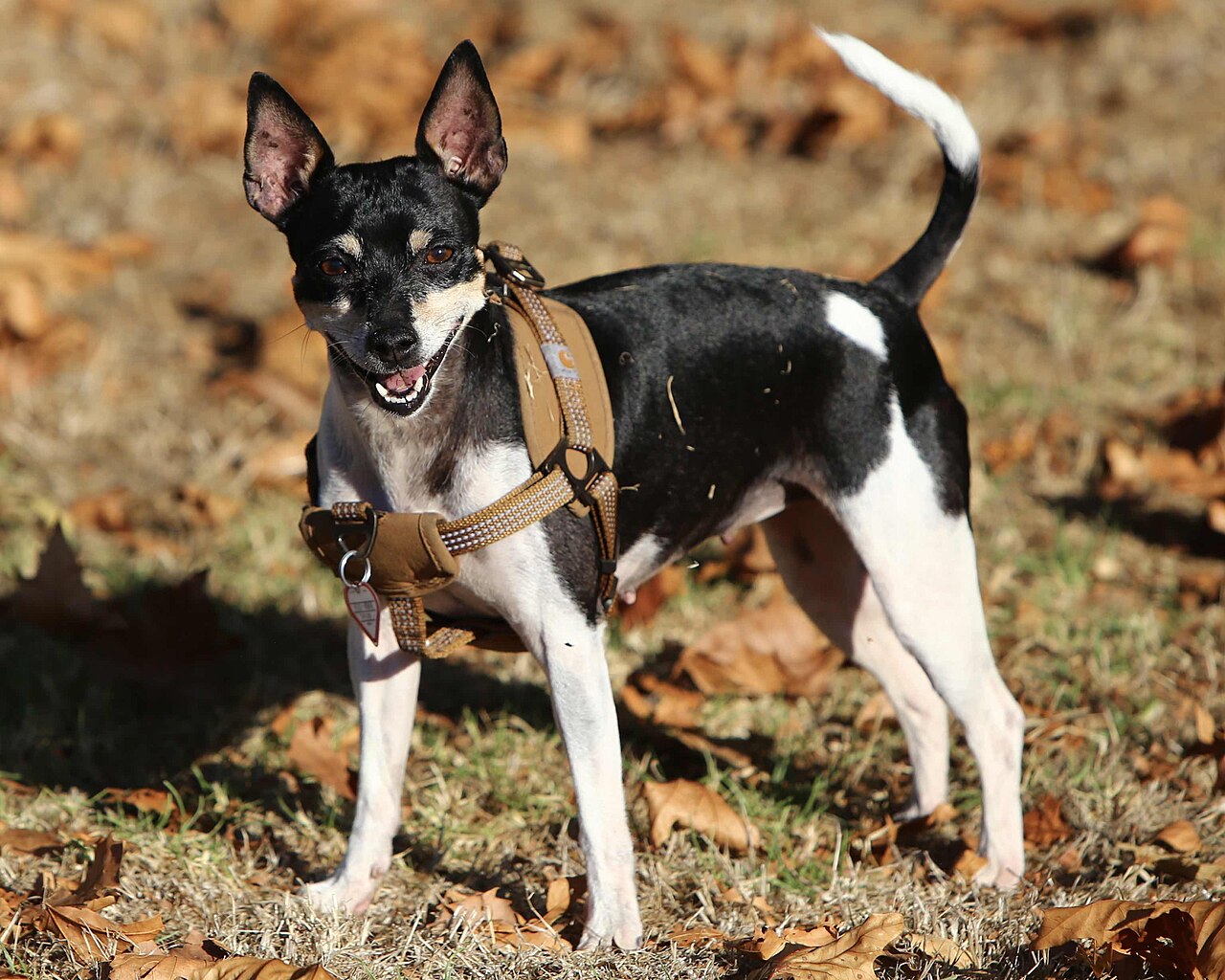
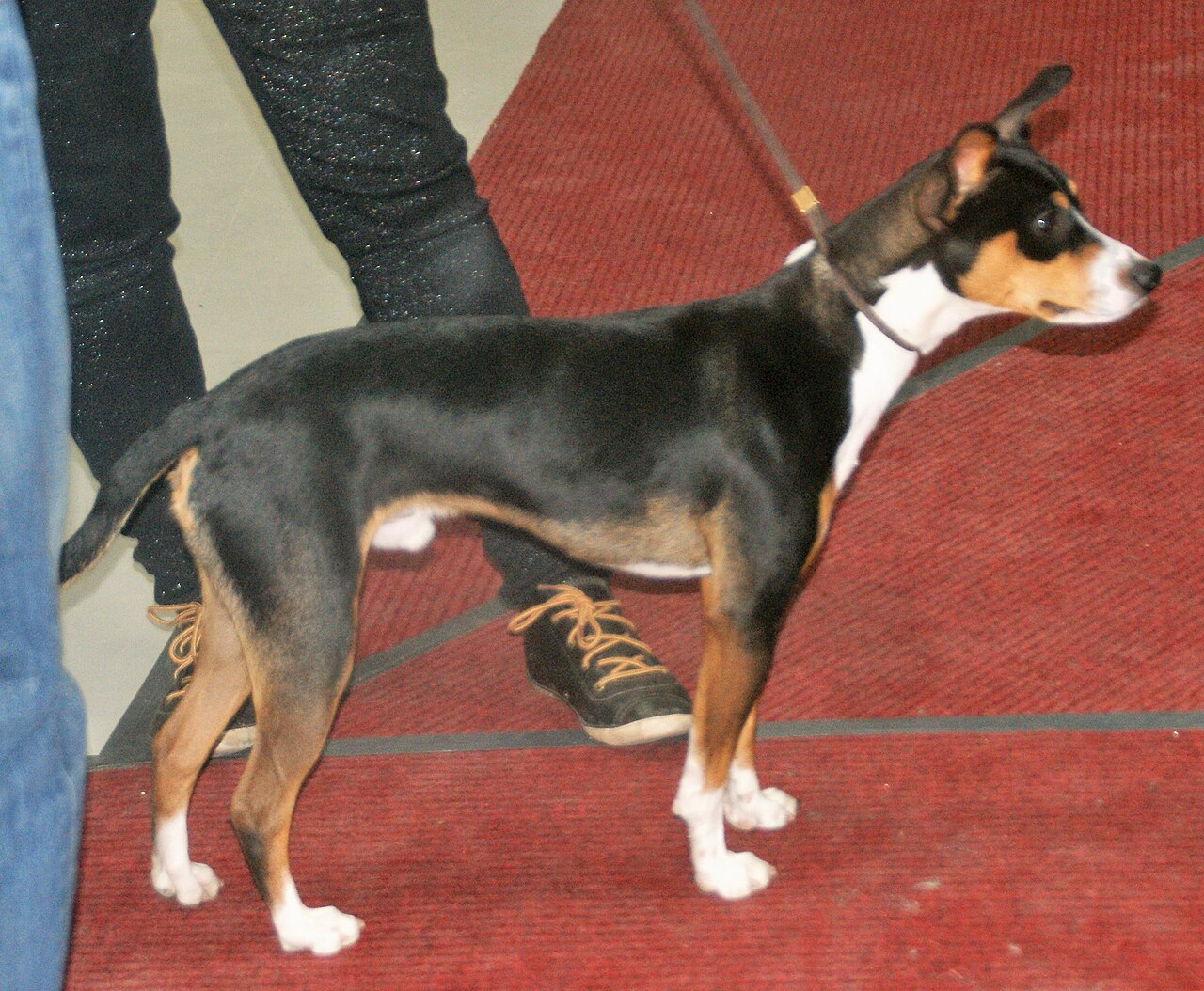
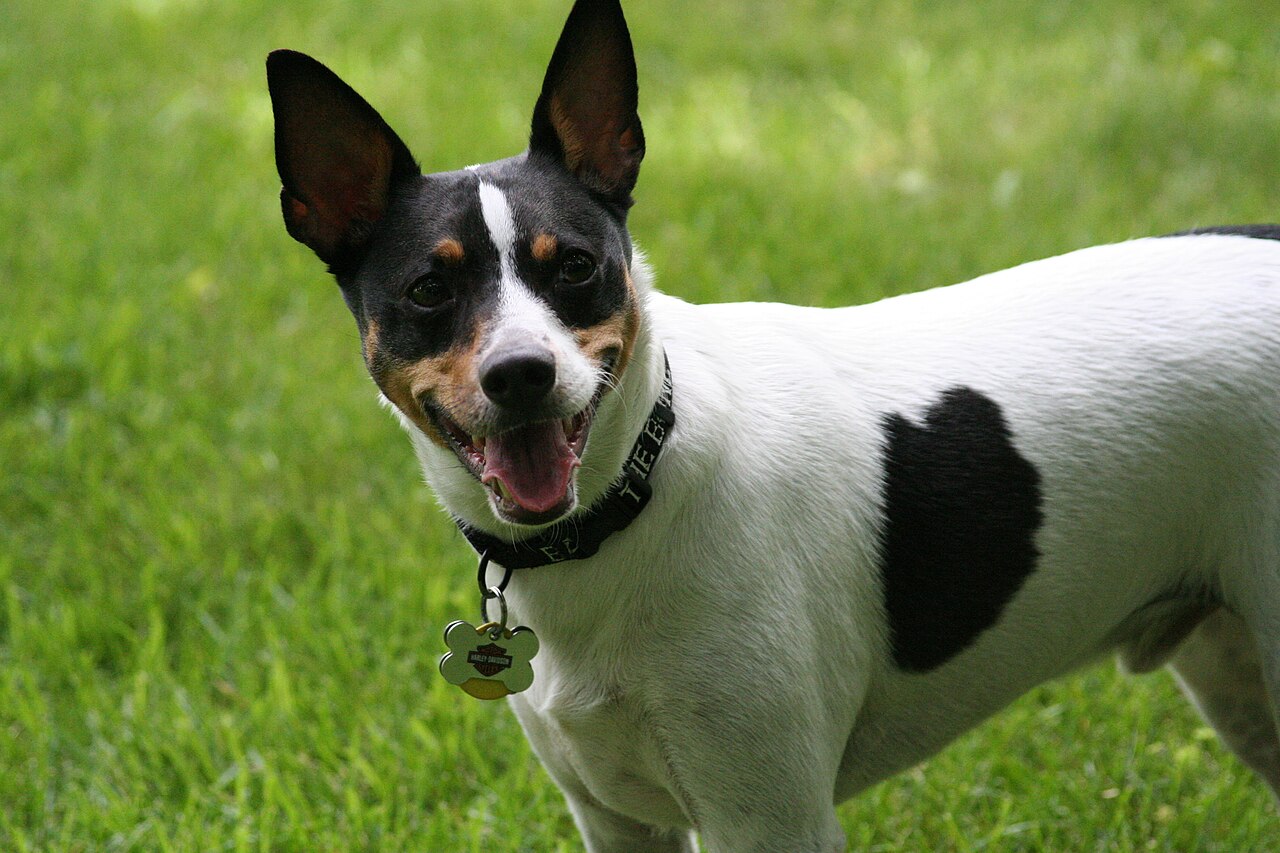
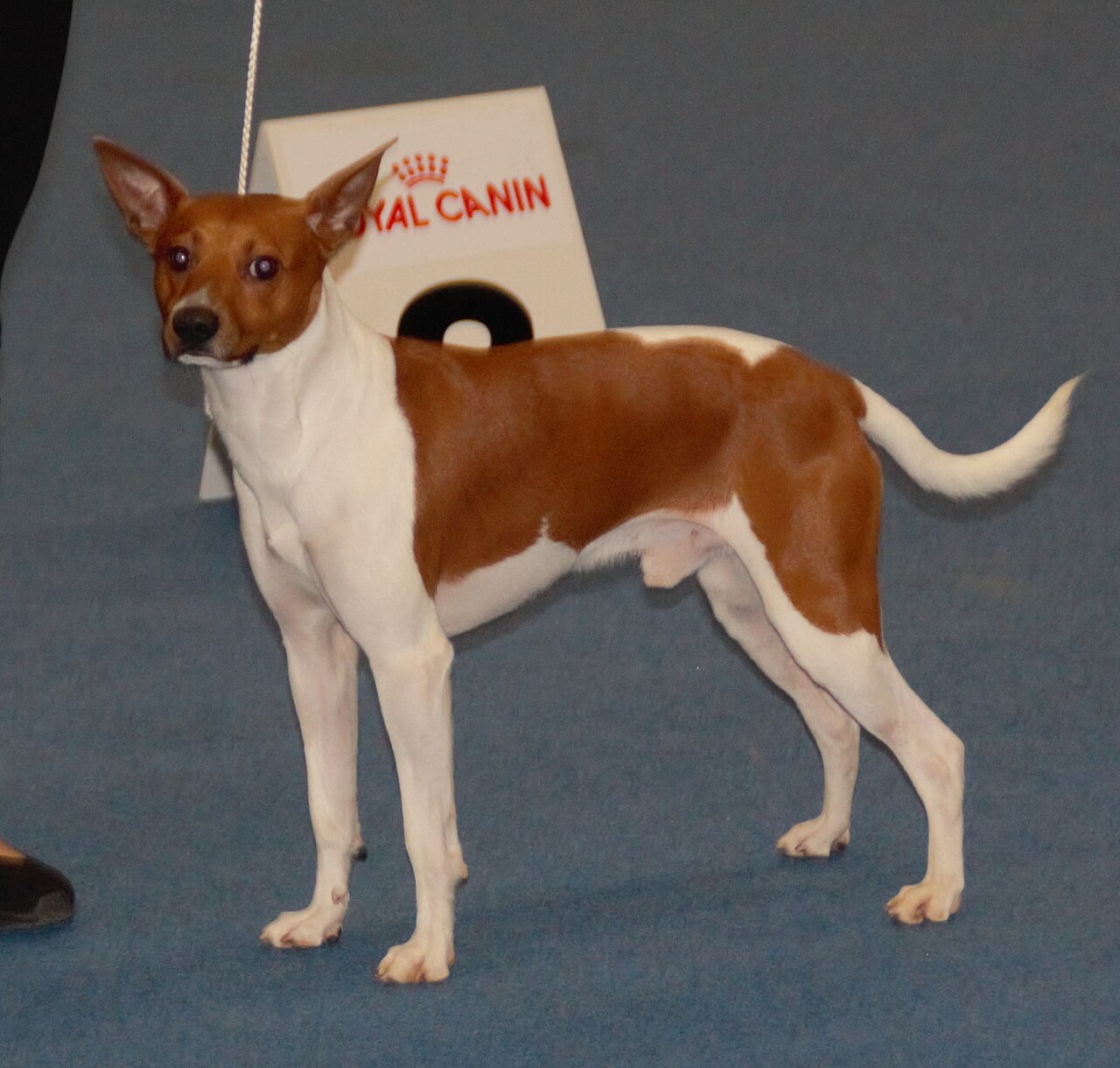
A sturdy, compact, smooth-coated terrier, slightly longer than tall, with a blunt wedge-shaped head and V-shaped ears that may be erect, semi-erect or button. The coat is short, close-lying and shiny. The breed is always pied: large patches of black, chocolate, red, apricot, blue, fawn, tan or lemon combined with white, often with tan points. The tail is customarily docked in the US, but a natural bobtail or a full-length tail is equally correct. Solid colors without white, brindle, merle, blue eyes, cropped ears and hairlessness are disqualifications.
| Miniature | Standard | |
|---|---|---|
| Height | 10-13 in | over 13 in, up to 18 in |
| Weight | the lighter end of 10-25 lbs | the heavier end of 10-25 lbs |
| Lifespan | about 12-18 years | about 12-18 years |
| Coat | Short, smooth and shiny | Same |
Heights are from the AKC standard (approved 2009, effective 2010); any dog under 10 or over 18 inches is disqualified. The AKC gives one weight range of 10-25 pounds for both sizes and a life expectancy of 12-18 years. The UKC uses the same two sizes. "Toy" Rat Terriers under 10 inches and "Decker" dogs over 18 inches cannot be shown in the AKC.
Exercise and daily life
The AKC rates the Rat Terrier 4 out of 5 for energy and 5 out of 5 for mental stimulation needs. Some get enough exercise from indoor play, but most do best with daily walks plus ball games in a fenced yard. Part of the daily program should be for the brain: sniffing games, tricks, puzzle toys. Many love dog sports. The AKC opened Earthdog tests to the breed in 2006, and Rat Terriers also do well in agility, barn hunt, lure coursing and rally.
The AKC is blunt: a Rat Terrier "should never be allowed off lead" in the open, because prey drive wins over recall. A secure fence matters more than a big yard. An adult that gets its exercise is a good apartment dog; the AKC gives it 4 out of 5 for adaptability. The thin single coat means it gets cold quickly, so a coat in winter is sensible.
Training
The AKC calls the Rat Terrier "extremely intelligent and trainable" and gives it 5 out of 5 for trainability, which is rare for a terrier. It is "unusually sensitive and intuitive", loves to please, and "responds quickly to positive training methods". Some can be stubborn. Short sessions with food, toys and praise work; harsh corrections do not.
Typical difficulties:
- Recall around prey. Use a long line in open areas, and do not expect a reliable recall when a squirrel runs.
- Digging and escaping. Give it a digging spot or a sandbox, and check the fence for gaps and low spots.
- Watchdog barking. Thank it once, call it away and reward quiet.
- Shyness with strangers. Early socialization is a must, according to the AKC, and puppy classes are recommended.
Grooming
Very easy. The AKC says a weekly once-over with a soft brush or hound glove is enough, and a bath every month or so. Shedding is moderate (AKC: 3 out of 5) and heavier during seasonal sheds, when a rubber curry brush helps. It is not a hypoallergenic dog.
Trim nails at least monthly and check the ears weekly. The AKC recommends brushing teeth daily if possible.
Health
The RTCA calls Rat Terriers "generally hardy dogs that can enjoy a long, healthy life". The AKC notes that responsible breeders screen for:
- Hip dysplasia, which is checked with OFA or PennHIP X-rays.
- Luxating patella (slipping kneecap), common in small breeds.
- Legg-Calve-Perthes disease, a hip problem of small dogs.
- Heart disease, checked with a cardiac exam.
- Eye disease, especially primary lens luxation (PLL), for which there is a DNA test.
- Weight gain. The AKC warns that some Rat Terriers get fat easily, so measure food and count training treats.
In its June 2025 health statement, the RTCA lists four required tests for breeding dogs, the same as for a CHIC number: a cardiac evaluation, hips, patellas and a PLL DNA test. Optional tests are a Legg-Calve-Perthes X-ray, an eye exam by an ACVO ophthalmologist, a BAER hearing test, elbows and a DNA test for PRA-prcd. The club also asks breeders to watch for seizures, the CDDY disc risk gene, Cushing's and Addison's disease. Ask for the four required results for both parents and check them in the OFA database.
Cost
Rat Terriers are not expensive by purebred standards. Breeder listings with AKC papers and health-tested parents are mostly around $900 to $1,600, show-line puppies can cost more, and price guides start as low as $600. Very cheap puppies without papers or health tests are usually from backyard breeders. The RTCA's "Find a Rat Terrier" page and the AKC Marketplace are good places to start, and breed rescues place adult dogs for a few hundred dollars.
Running costs are about $700 to $1,200 a year for food, routine vet care and preventives; pet insurance adds to that. Grooming costs almost nothing, but budget for a solid fence, training classes and maybe a dog sport. Most states require a rabies vaccination, and many cities a dog license. Several states also have puppy "lemon laws" that give you rights if a puppy from a seller turns out to be sick.
Who it suits and who it does not
Good match for:
- Active families with kids who want a sturdy, playful small dog
- People who want a terrier that is actually easy to train
- Dog sport fans looking for an agility, barn hunt or earthdog partner
- Owners who want a wash-and-go coat
Not a match for:
- Homes with hamsters, rats, rabbits or pet birds
- People who want off-leash walks in open country
- Owners who are away all day and cannot give daily exercise
- People who want a quiet, non-shedding lapdog. For a similar look in a tiny size, try the Toy Fox Terrier; for the hairless relative, the American Hairless Terrier; for a classic small working terrier, the Jack Russell Terrier