Origin and history
The Pumi (plural Pumik, say "poo-mee") is a medium-sized herding dog from Hungary with a terrier streak. The FCI standard says it came into being in the 17th and 18th centuries, when the primitive Puli was crossed with prick-eared, terrier-type dogs imported from Germany and France. Hungarian shepherds used it to drive and gather sheep, cattle and pigs, and to keep the farm free of rats and other vermin. Its early history is shared with the Puli and the Mudi, the other two small Hungarian herders.
The name appears in print as early as 1815, but for a long time the Pumi was treated as a regional variety of the Puli. Separate standardization began in the early 20th century: the first Pumi standard was written in 1921, and the FCI approved the breed in 1935. Today it is FCI standard No. 56, Group 1, Section 1 (Sheepdogs), without working trial; the current text dates from 2000. Hungary still has the largest population, and the breed is well established in Finland and Sweden.
In the US the Pumi entered the AKC Foundation Stock Service in 2004 and the Miscellaneous Class on January 1, 2011. The AKC named the Hungarian Pumi Club of America (HPCA) its parent club in 2015, and the Pumi joined the Herding Group on July 1, 2016, as the 190th recognized breed. It is still rare: the club says only a few litters are born in the US each year, and it ranked 169th of 210 breeds in AKC registrations in 2024.
Temperament and character
The FCI standard describes a lively herding dog with a restless temperament, "extremely bold, a little suspicious towards strangers", and states plainly: "The Pumi is rather noisy." The AKC calls the breed famed for its intelligence, agility and boldness. In daily life:
- It is always on. The standard says all parts of its body are constantly on the move. A Pumi watches, thinks and reacts to everything around it.
- It uses its voice. Barking is part of how it controls stock. The HPCA calls Pumik "vocal dogs" and says socialization reduces the barking, "but it's a process that never ends".
- It is wary of strangers. The club says Pumik can seem stand-offish with people they don't know. With their own family they are close and playful.
- It is sensitive and clever. The club warns that the breed is more sensitive to rough treatment than many others and that a smart Pumi will exploit an owner who is not consistent.
The AKC rates it in the middle for young children and for other dogs. Raised with them, most Pumik do fine, but like any herder it may try to round up running kids.
Size and appearance
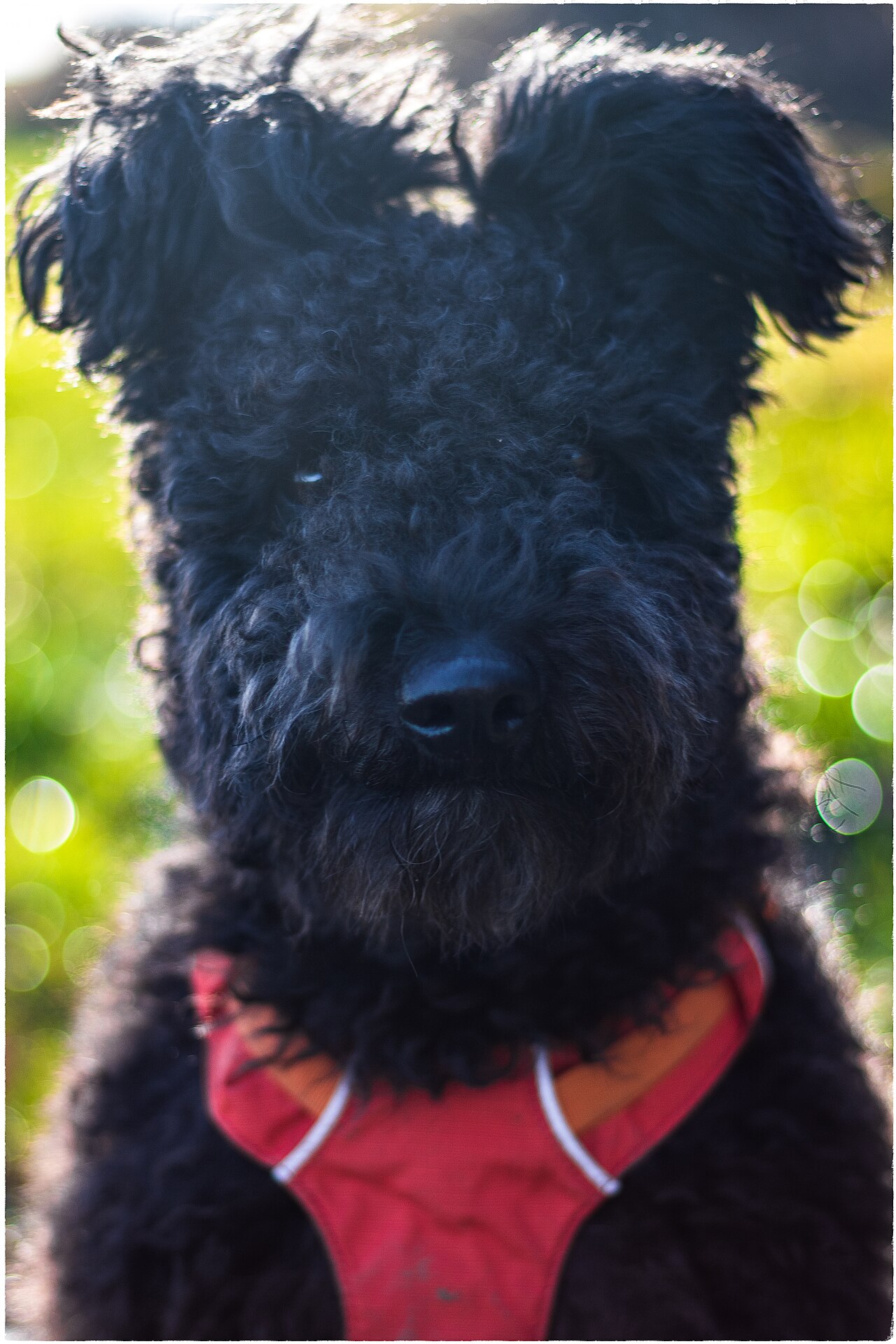
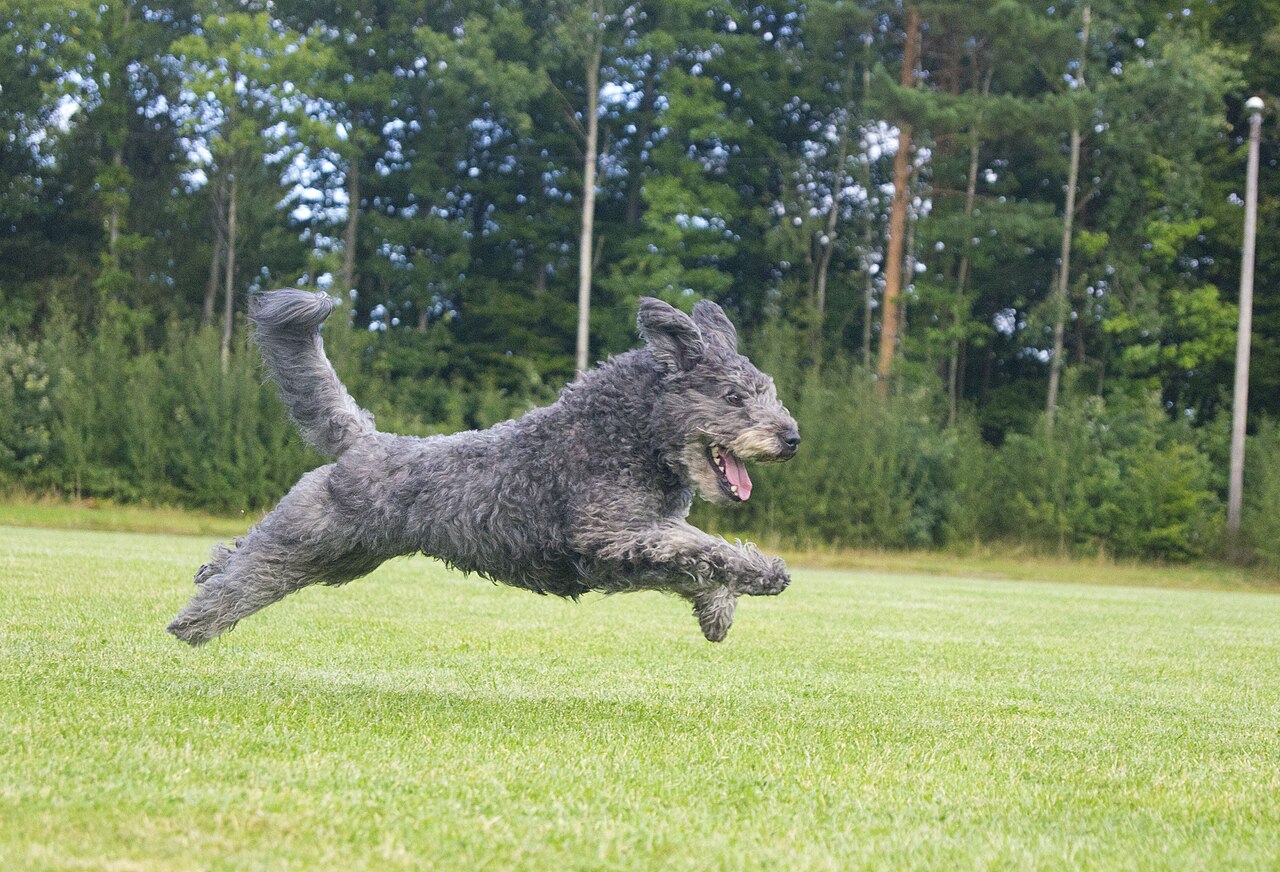
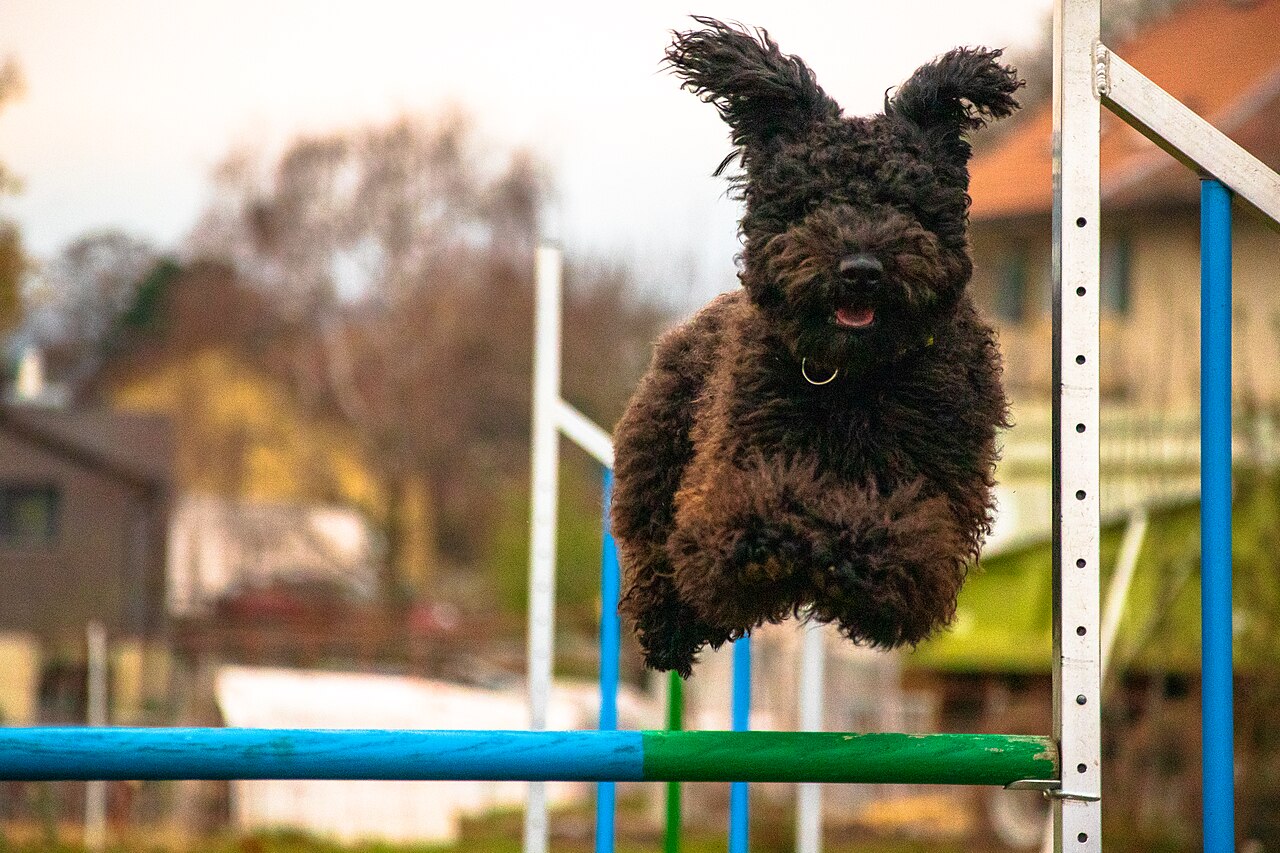
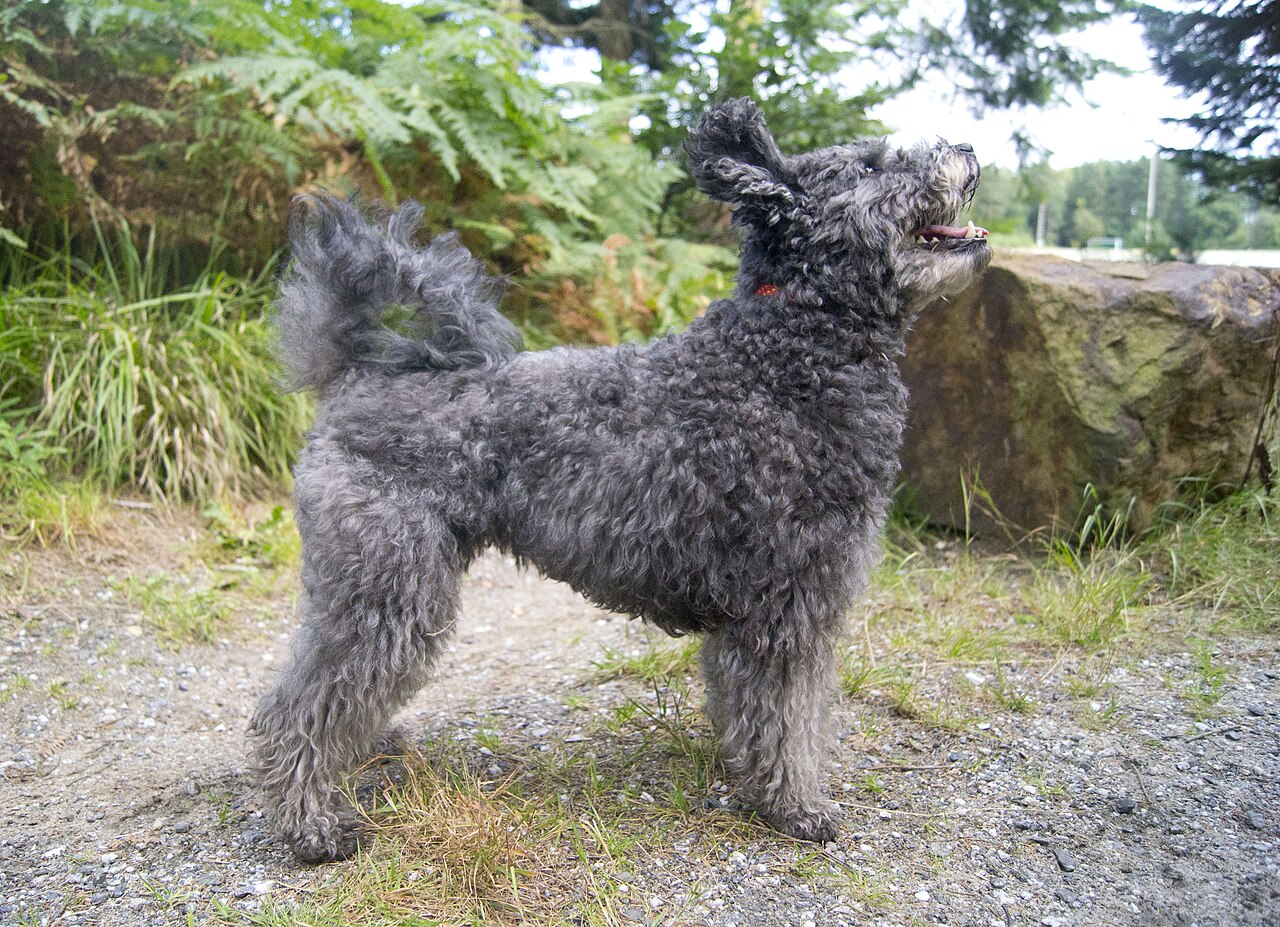
A square, lean, medium-sized dog with a long, narrow head and a terrier-like expression. The ears are the trademark: set high and upright, with the top third tipping forward. The tail is set high and forms a wide circle over the back; the FCI standard does not allow a natural bobtail or docking. The coat is wavy to curly, about 1.5 to 3 inches long, and forms tufts; it is never corded like the Puli's. Colors: gray in many shades (most common; these puppies are born black and lighten with age), black, fawn and white, always solid.
| Males | Females | |
|---|---|---|
| Height | 16-18.5 in (FCI 41-47 cm) | 15-17.5 in (FCI 38-44 cm) |
| Weight | 27-29 lbs ideal (FCI 10-15 kg) | 22-24 lbs ideal (FCI 8-13 kg) |
| Lifespan | 12-14 years | 12-14 years |
| Coat | Curly, in tufts, about 1.5-3 in | Same |
Heights and ideal weights are from the AKC standard. The AKC lists a life expectancy of 12-13 years; the HPCA says Pumik routinely live 13-15.
Exercise and daily life
The AKC rates the Pumi at the top of its energy scale and its need for mental stimulation. The HPCA is blunt: these dogs "require enormous amounts of exercise, attention, mental stimulation and a task to do around the house". Plan on one to two hours of real activity a day, plus training or a sport: agility, herding, obedience, nose work, flying disc. The AKC notes that Pumik love tennis balls and discs, climb over and under things and like to sit up high to watch what is going on.
Given work, a Pumi is a good house dog, and the FCI standard says it can definitely be kept indoors. An apartment is possible but hard: thin walls and a dog that reports every noise in the hallway are a bad mix. A house with a secure fence is easier. Without enough to do, a Pumi invents its own jobs, usually barking and digging.
Training
The AKC gives the Pumi top marks for trainability: it learns quickly and has "a boundless willingness to work without being obsessive about it". It is also a thinking dog that assesses each new situation, so early and ongoing socialization is essential. Reward-based training with short, varied sessions works best. Harshness backfires with this sensitive breed.
Typical difficulties:
- Barking. The AKC advises never to reinforce it. Teach "speak" and "quiet" as a pair, and reward silence.
- Suspicion of strangers. Meet many calm people and places before 16 weeks, and keep at it through adolescence.
- Testing the rules. Be consistent from day one; a Pumi notices every exception.
- Herding and chasing. Redirect nipping at heels and chasing bikes into games and a sport.
Grooming
Moderate, but not the high upkeep of a corded or show-clipped breed. The AKC says the coat is half soft and half harsher hair and needs combing every three to six weeks, followed by wetting the coat so the curls come back. Every couple of months the coat is trimmed to keep its shape and the typical ear tufts; the FCI standard prefers hand trimming, with scissors only for small corrections on the head and legs. Never blow-dry it: that removes the curls.
The AKC says the Pumi does not shed, though hair comes out when you comb it. Some people with mild dog allergies cope well with it, but the Pumi is not a hypoallergenic breed, and allergens are also in dander and saliva. If you have allergies, spend time with adult Pumik before you commit.
Health
The HPCA calls the Pumi "basically a healthy breed" and says hip dysplasia appears to be its most common problem. In the OFA database (end of 2024), about 9 percent of evaluated Pumik had abnormal hips. What to know:
- Hip dysplasia. The club recommends hip X-rays for every Pumi, bred or not.
- Luxating patella (slipping kneecap), checked by a vet exam.
- Primary lens luxation (PLL), an inherited eye disease. In the OFA data, about 12 percent of DNA-tested Pumik are carriers.
- Degenerative myelopathy (DM), a late-onset spinal disease. About 10 percent of tested dogs are carriers.
- Elbow dysplasia. Less common, but about 7 percent of evaluated elbows were abnormal, so the optional X-ray is worth asking for.
For CHIC certification the HPCA requires a hip evaluation, a patella evaluation and DNA tests for PLL and DM; an elbow evaluation, an eye exam by an ACVO ophthalmologist and a DNA repository sample are optional. Ask for the results for both parents and look them up in the OFA database. Carriers can be bred, but never carrier to carrier. The club also recommends brucellosis testing before every breeding.
Cost
Few litters, so expect a waiting list, and a longer one if you want a particular color or sex. The HPCA lists member breeders by state. Breeder listings we found on Good Dog ask $3,100 to $3,450, and Canadian price guides quote CAD 2,200 to 4,800, so budget about $2,500 to $3,500. Health-tested parents and AKC registration are worth the price. Be wary of cheap "Pumi" or "Pumi mix" puppies; at this rarity, they are rarely what they claim.
Running costs: roughly $1,000 to $1,800 a year for food, routine vet care, preventives, insurance and a few trims. You can learn to trim the coat yourself; a groomer who knows the breed costs more. Budget for a training class or dog sport, too.
If a puppy is not realistic, ask the club about adult dogs: breeders sometimes place retired or returned Pumik, and an adult needs less round-the-clock training than a puppy.
Who it suits and who it does not
Good match for:
- Active owners who want a small, quick partner for agility, herding or obedience
- Homes with a fenced yard, farms included: the Pumi still herds and hunts vermin
- People who want a watchful dog that warns of visitors without being big
- Experienced owners who enjoy a clever, opinionated dog and don't mind regular trims
Not a match for:
- First-time owners who are not ready to train every day
- Homes where barking causes trouble with neighbors, or dogs left alone all day
- People looking for a calm couch dog. For a similar Hungarian herder with an easier coat, see the Mudi; for the corded cousin, the Puli; for a curly, low-shedding dog with a softer social side, the Lagotto Romagnolo; for a smaller, more relaxed watchdog, the Miniature Schnauzer