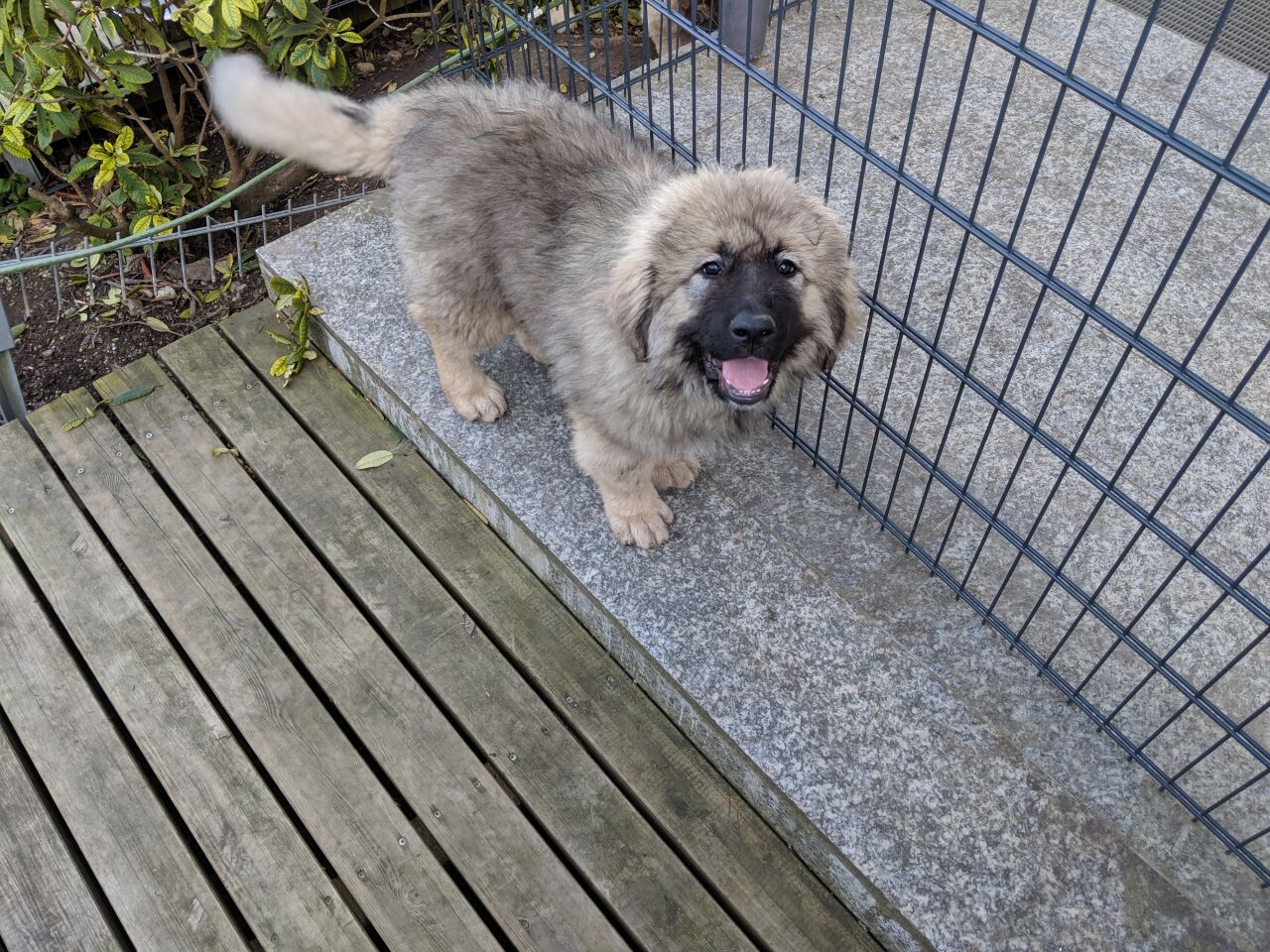
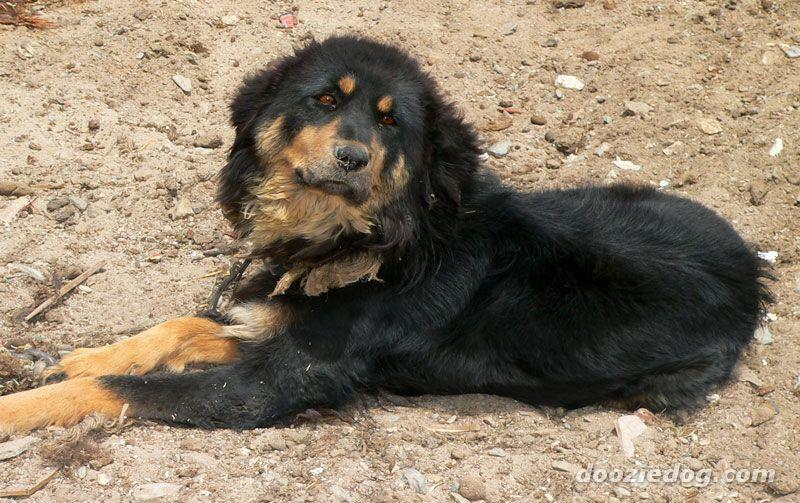
The Caucasian Shepherd Dog and the Tibetan Mastiff are one idea in two versions: a huge, heavy-coated mountain guardian that decides for itself who belongs on its land. They share every one of our ratings except shedding, and neither is a family pet in the usual sense. The Caucasian Shepherd comes from the Caucasus, today Georgia, Armenia, Azerbaijan and southern Russia, where it guarded flocks and homes; per the FCI standard, systematic breeding began in the USSR in the 1920s. The Tibetan Mastiff (Do Khyi) worked for the nomad herders of the Himalaya and guarded Tibetan monasteries; it was traditionally chained at the gate and let loose at night. How they differ:
- Size. The Caucasian Shepherd is the bigger: the AKC lists 23-30 in and 99-170 lbs, and the FCI standard asks for at least 68 cm (26.8 in) in males and 64 cm (25.2 in) in females. For the Tibetan Mastiff the AKC sets only minimum heights, 26 in for males and 24 in for females, with weights of 90-150 and 70-120 lbs. The Tibetan Mastiff matures slowly, males not before 4 years.
- Guarding. The sources describe the Caucasian Shepherd in harder terms. The AKC calls it "a serious guardian breed", fierce when a threat is present but soft with its family. It calls the Tibetan Mastiff watchful and aloof, territorial with strangers. Still, the American Tibetan Mastiff Association (ATMA) warns that a Tibetan Mastiff may not let your friends into the house.
- Noise. The Tibetan Mastiff is a known night barker; ATMA says owners with close neighbors bring their dogs in at night.
- Coat. The Caucasian Shepherd sheds through the year; the Tibetan Mastiff keeps its coat most of the year, then blows the whole undercoat at once in spring or summer. Hence one point less on shedding.
- Heat cycle. Tibetan Mastiff females come into heat only once a year, usually in autumn, per ATMA.
- Status and price. The Tibetan Mastiff has been in the AKC Working Group since 2007; the Caucasian Shepherd is still in the AKC Foundation Stock Service. A puppy costs about $1,000-$3,000 for a Caucasian Shepherd and $2,000-$5,000 for a Tibetan Mastiff. In China one Tibetan Mastiff reportedly sold for 10 million yuan (about $1.5 million) in 2011, a figure doubted even then; the fad collapsed and many dogs were discarded.
- Travel. Two German states, Hesse and Hamburg, list the Caucasian Shepherd as a presumed dangerous breed; neither lists the Tibetan Mastiff. Denmark bans the Caucasian Shepherd outright, even for tourists on holiday. France and the Netherlands restrict neither breed.
Joints are the main worry at this size. The OFA's CHIC program requires hip and elbow X-rays and a DNA test for degenerative myelopathy for breeding Caucasian Shepherds, and hips, an eye exam and a thyroid test, elbows optional, for breeding Tibetan Mastiffs. ATMA names hip and elbow dysplasia, hypothyroidism and seizures as the breed's known problems, and warns that heat and humidity are hard on it. Ask the breeder for the parents' results.
Be honest first: both are livestock and property guardians, and for most homes, especially first-time owners, apartments and households with many visitors, neither is the right dog. With land, a high fence, few visitors and experience with guardians, pick the Caucasian Shepherd to guard stock and land full-time. Pick the Tibetan Mastiff if it will be part of the household, on land but sleeping indoors: ATMA says it does not adapt well to life as an outside dog, and those that sleep in the house are rarely a barking problem. For the size without the guarding, the Leonberger and the Newfoundland are big family dogs; for another flock guardian, compare the Great Pyrenees, the Anatolian Shepherd and the Kangal.