Origin and history
The Kangal is Turkey's national dog, a livestock guardian bred to protect sheep and goats from wolves, bears and jackals. The UKC standard says Turkic tribes migrating into Anatolia from the 11th century most likely brought their own working dogs, though how much the modern breed owes to them rather than to dogs already native to Anatolia is still an open question. The breed is named for the Kangal District of Sivas Province in central Turkey, but the dogs were found all over the high Anatolian plateau, guarding flocks near villages and on the summer pastures called yaylas.
Registries do not agree on what to call it. The AKC does not register the Kangal; the closest breed it recognizes is the Anatolian Shepherd. The UKC has recognized the Kangal Dog since 1998, and its parent club, the Kangal Dog Club of America (KDCA), keeps it separate from the Anatolian. The FCI went the other way: in 2018 its Kangal standard (No. 331) replaced the Anatolian Shepherd standard, and Anatolians may only be re-registered as Kangals if they fit it. The first Kangals came to the US in 1985, imported by David and Judith Nelson after their fieldwork on guardian dogs in Turkey.
Temperament and character
The UKC describes a dog that is alert, territorial and defensive of the animals or family it has bonded with. In daily life:
- It intimidates first. Kangals prefer to scare predators off, says the UKC, but will take a physical stand and even attack if necessary.
- It is wary of strange dogs, not people. The standard notes an instinctive wariness of strange dogs, while the breed is not typically belligerent toward people.
- It thinks for itself. The KDCA calls Kangals independent thinkers who see little point in repeating tricks, and who will ignore you if something more interesting is happening in the neighborhood.
- It is not a protection dog. According to the KDCA, the Turkish military tested the breed for police work and found it unsuitable.
With its own family, children and livestock it is usually gentle. The KDCA's warning is blunt: do not expect a Kangal to calmly welcome uninvited guests on your property.
Size and appearance
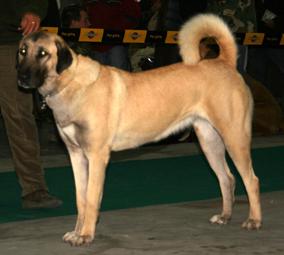
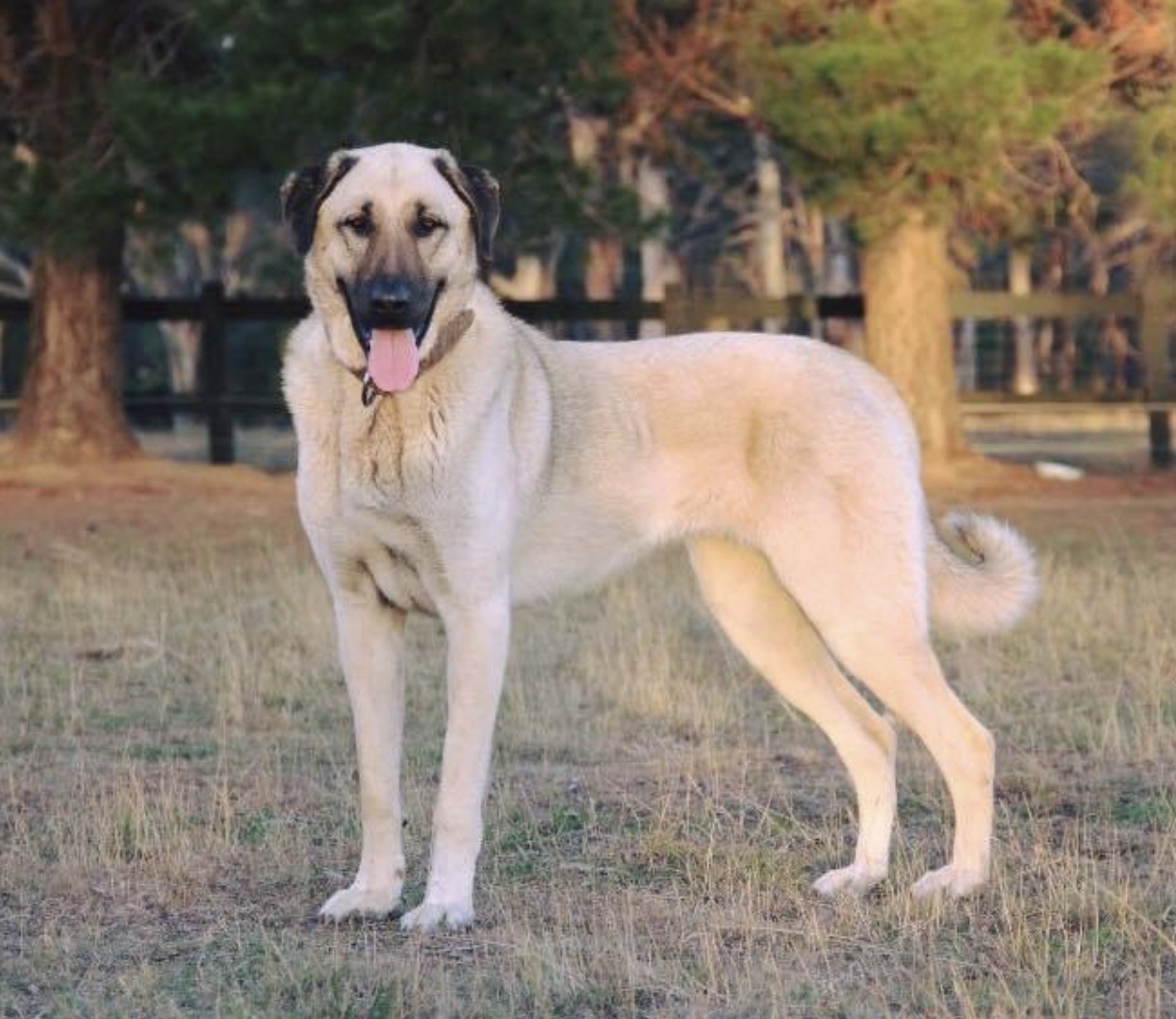
A large, powerful dog, slightly longer than tall, with drop ears and a tail curled over the back when alert. The base color ranges from cream to pale tan or fawn, sometimes grayish, always with a dark mask. White is allowed only on the feet, chest and chin.
| Males | Females | |
|---|---|---|
| Height (UKC) | 29-33 in (74-84 cm) | 27-31 in (69-79 cm) |
| Weight (UKC) | 110-145 lbs (50-66 kg) | 90-130 lbs (41-59 kg) |
| Lifespan | 12-15 years | 12-15 years |
| Coat | Fairly short, dense double coat | Same |
The UKC says dogs may exceed these figures without penalty if they stay balanced. The FCI standard sets smaller dogs (males 72-78 cm, up to 60 kg). The height range at the top of this page, 28-32 in (71-81 cm), sits between the two standards; the weight there follows the UKC. The lifespan comes from Dogs Victoria, an Australian kennel club.
Exercise and daily life
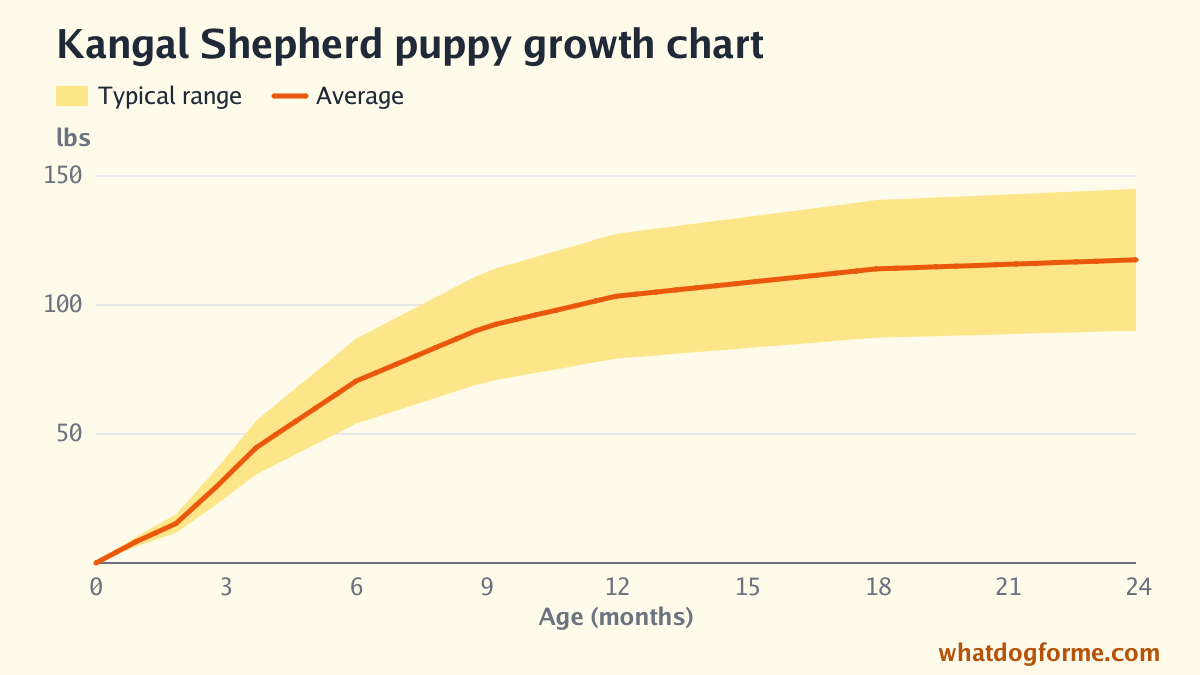
A Kangal does not need to run 20 miles a day, the KDCA says, but it does need regular, steady exercise. A normal yard is too small for a Kangal to exercise itself. Plan daily walks on lead, and with a growing puppy, increase distance slowly, since big-boned dogs grow in spurts and get hurt easily.
Fencing is not optional. The KDCA reports Kangals climbing 6-foot fences and digging under them, and says you cannot trust one off leash unless you live somewhere extremely remote. Expect barking, and roaring, at night when coyotes are about. That is how the dog works, and your neighbors will hear it.
Training
Kangal puppies are often easy to house-train and seem like angels, writes the KDCA. Then, at six months to a year and 80 to 130 pounds, they stop coming when called, pull on the leash or start guarding the food bowl. The club urges puppy classes and basic obedience even when everything seems fine.
Typical difficulties:
- A recall that works only when nothing more interesting is around.
- Explosive reactions to surprise dogs on walks; owners use head halters and double-handled leads.
- Guarding that makes the yard off-limits to visitors.
Grooming
Low effort most of the year. The KDCA says Kangals shed their undercoat twice a year, and in those weeks it comes out in quantity, so brush daily. Otherwise an occasional brushing is enough. Trim nails and check ears. Turkish village dogs live on barley mash and bread, grow slowly and are never fat; keep yours lean too.
Health
Hill's calls the breed generally robust and resilient. Conditions to know by name:
- Hip dysplasia. The KDCA code of ethics requires an OFA hip rating of fair or better at 24 months or more, or a PennHIP distraction index of 0.46 or less.
- Elbow dysplasia. Dogs born on or after January 1, 2021 also need OFA elbows rated normal before breeding.
- Entropion. The eyelid rolls inward and lashes irritate the eye (Hill's).
- Bloat (GDV). Hill's advises smaller, more frequent meals and no vigorous exercise after eating.
Ask to see for both parents: OFA or PennHIP hips, OFA elbows, and UKC registration. The KDCA also recommends patella, eye, cardiac and thyroid tests plus a DNA panel (for example degenerative myelopathy and von Willebrand disease). Its health committee says ATP7A/ATP7B copper tests have not been shown to predict liver disease in Kangals.
Cost
Puppies typically cost $1,500 to $3,500. KDCA-listed breeders are few, from California to Connecticut, and most expect to interview you before a litter. The club advises buying only puppies eligible for UKC registration, since many dogs sold as "genuine Kangals from Turkey" are not. Importing is possible, but the KDCA notes legal restrictions on exporting Kangals from Turkey.
Running costs come to roughly $1,500 to $2,500 a year: food for a 90-145 lb dog, vet care and preventives, which, as the club notes, cost more for big dogs. Add tall fencing before the puppy arrives.
Who it suits and who it does not
Good match for:
- Farms and homesteads that need a guardian for sheep or goats
- Experienced owners of large, independent guardian breeds such as the Great Pyrenees or Caucasian Shepherd
- Homes with acreage, a tall secure fence and tolerant neighbors
Not a match for:
- First-time owners; the KDCA says plainly that these dogs are not for them
- Apartments and small yards
- People who want a trained protection dog or a biddable sport dog
- Homes with a stream of visiting dogs