Origin and history
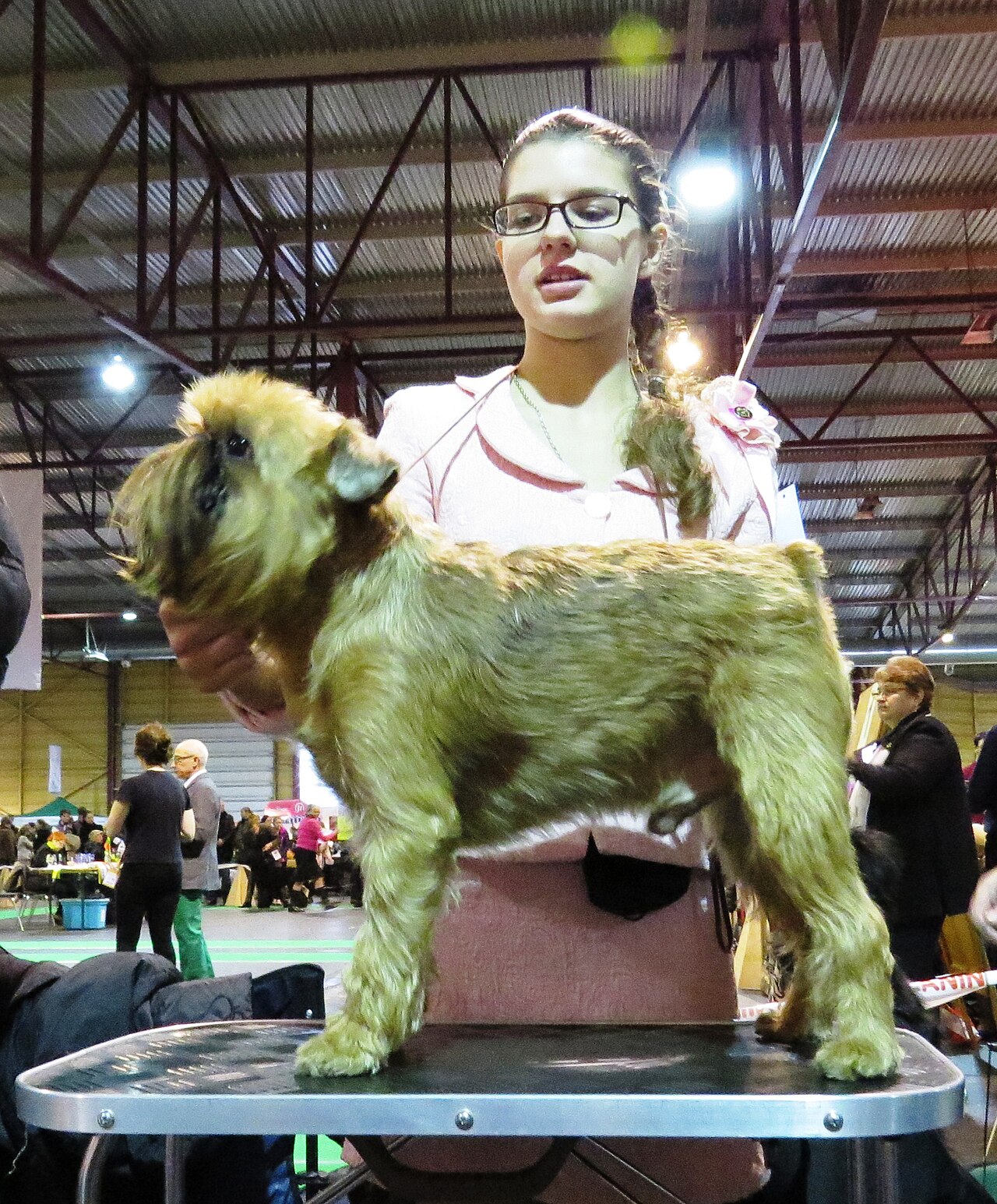
The Brussels Griffon, or "Griff", comes from Brussels, where coachmen kept small rough-coated dogs in their stables. The FCI standard says the breed descends from a little rough-coated dog called the "Smousje", found around Brussels for centuries, which was bred "to guard carriages and keep stables free from rodents". The AKC calls these stable dogs "griffons d'écurie" and notes that a small griffon-type dog already appears in Van Eyck's 1434 "Arnolfini Portrait".
In the 19th century breeders crossed in the Ruby King Charles Spaniel and the Pug. According to the FCI, this brought in the short black coat and fixed today's breed type. The first two Griffons, Topsy and Foxine, were entered in the Belgian stud book in 1883. Royal interest from Queen Marie-Henriette of Belgium made the breed fashionable around 1900, and dogs were exported to Britain and America. The AKC registered its first Griff in 1910. Both world wars nearly wiped the breed out in Europe, and the AKC credits US and British fanciers with saving it. A Griff named Jill reached a wide audience in the 1997 film "As Good as It Gets".
One breed in the US, three in Europe. This is the point that confuses most buyers:
| AKC (US) | FCI (Europe) | |
|---|---|---|
| Red, rough coat | Brussels Griffon | Griffon Bruxellois, FCI No. 80 |
| Black or black and tan, rough coat | Brussels Griffon | Griffon Belge, FCI No. 81 |
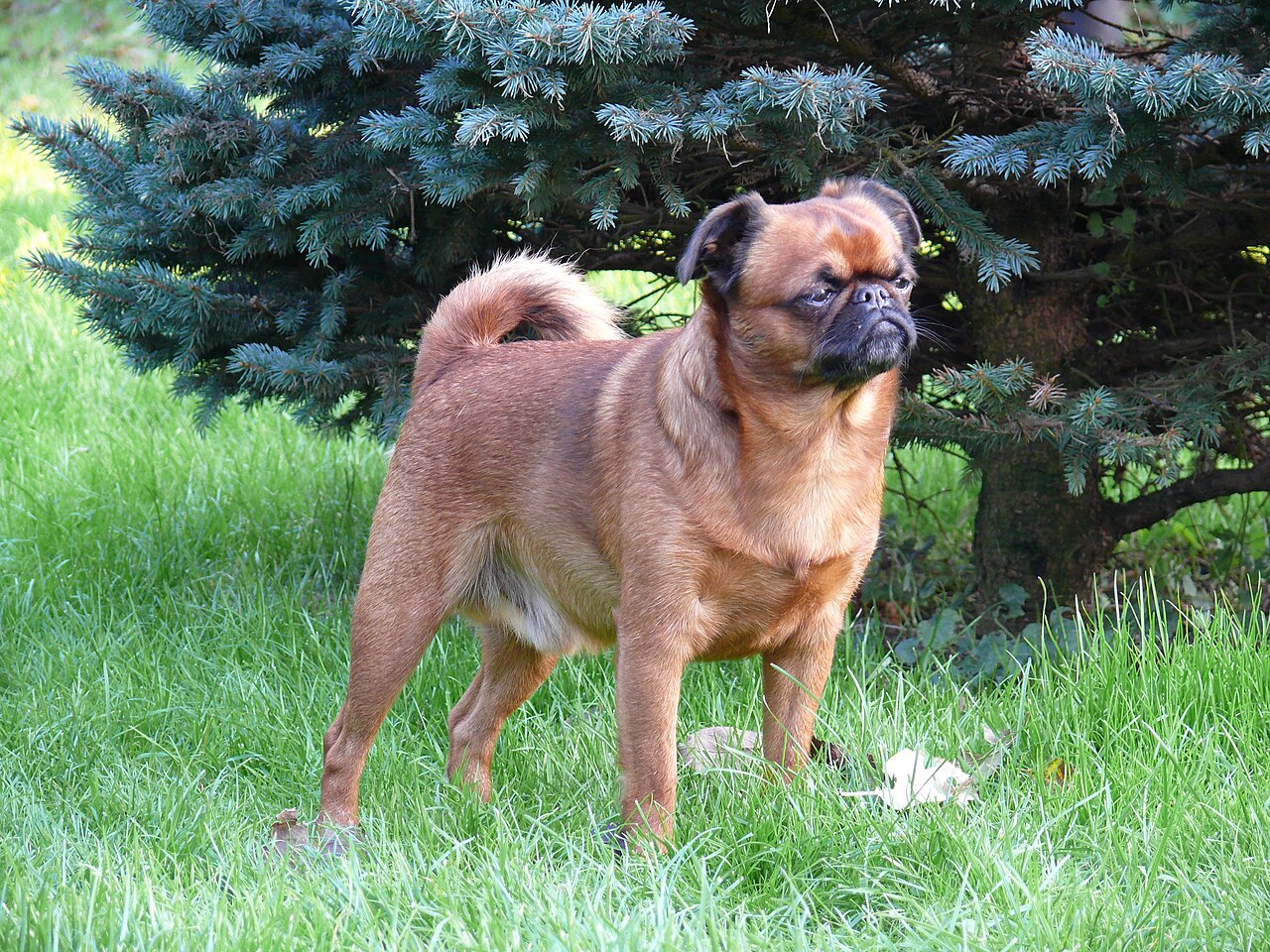
| Smooth coat, any of the colors | Brussels Griffon (smooth, also called "Brabançon") | Petit Brabançon, FCI No. 82 |
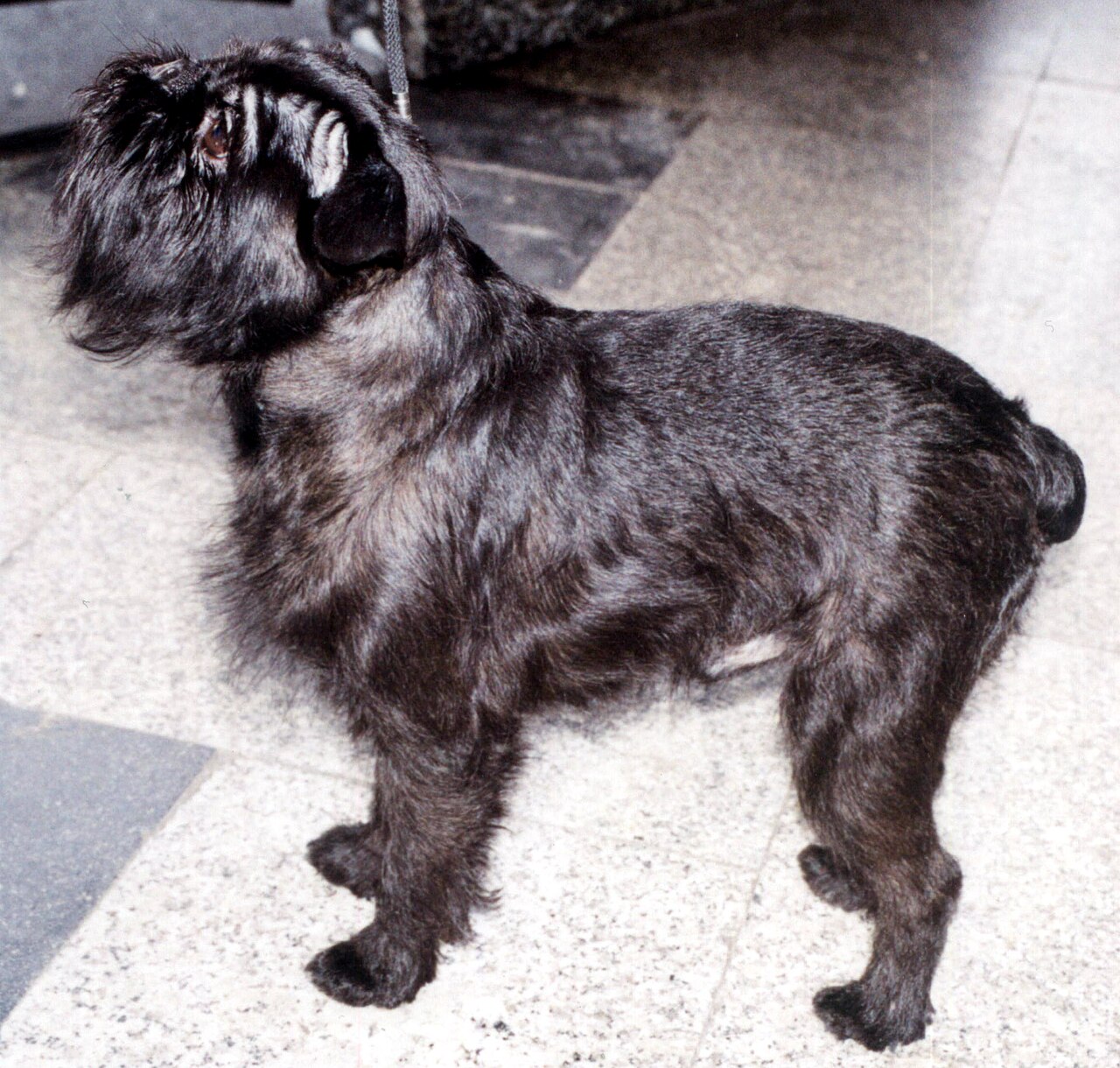
The AKC treats them as one breed in two coats and four colors: red, belge (black and reddish-brown mixed), black and tan, and black. Its standard says that "except for coat, there is no difference between the two". The FCI, with Belgium as the country of origin, splits them into three breeds that share one standard in Group 9 (Companion and Toy Dogs), Section 3 (Small Belgian Dogs), without working trial. The definitive FCI acceptance dates from 1954; the current standard from 2003.
In the US the American Brussels Griffon Association (ABGA) is the AKC parent club. The Griff sits in the AKC Toy Group and ranked 82nd in AKC registrations in 2025.
Temperament and character
The AKC sums it up as "smart, devoted, and comically self-important", "a sensitive companion for discerning grownups". The FCI standard describes a well-balanced little dog, "alert, proud, very attached to its owner, very watchful", and "neither timid nor aggressive". In daily life:
- It is a velcro dog. The ABGA says enthusiasts call Griffs "Velcro" dogs because they stay so close. The AKC adds that they have "a low threshold for loneliness" and often follow their person from room to room.
- It is sensitive. Harsh words or rough corrections backfire. The AKC notes that the breed can be self-conscious around strangers.
- It is not a toddler's toy. The AKC calls its small size and sensitive nature "a poor choice as roughhousing playmates for kids". Calm older children who sit on the floor to play are a better fit.
- It notices everything. It was bred to guard carriages, and the AKC rates it 4 out of 5 for barking. Expect it to announce visitors.
It is a former ratter, not a cushion dog: the AKC stresses that the Griff "is not typical of the pampered pet stereotype of toy breeds".
Size and appearance
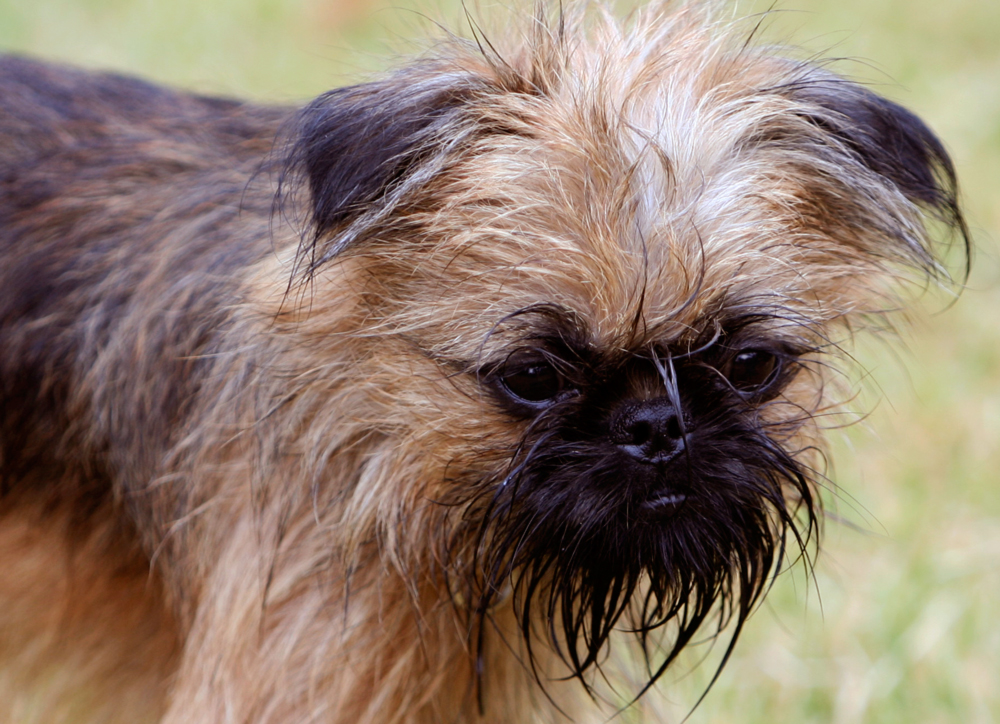
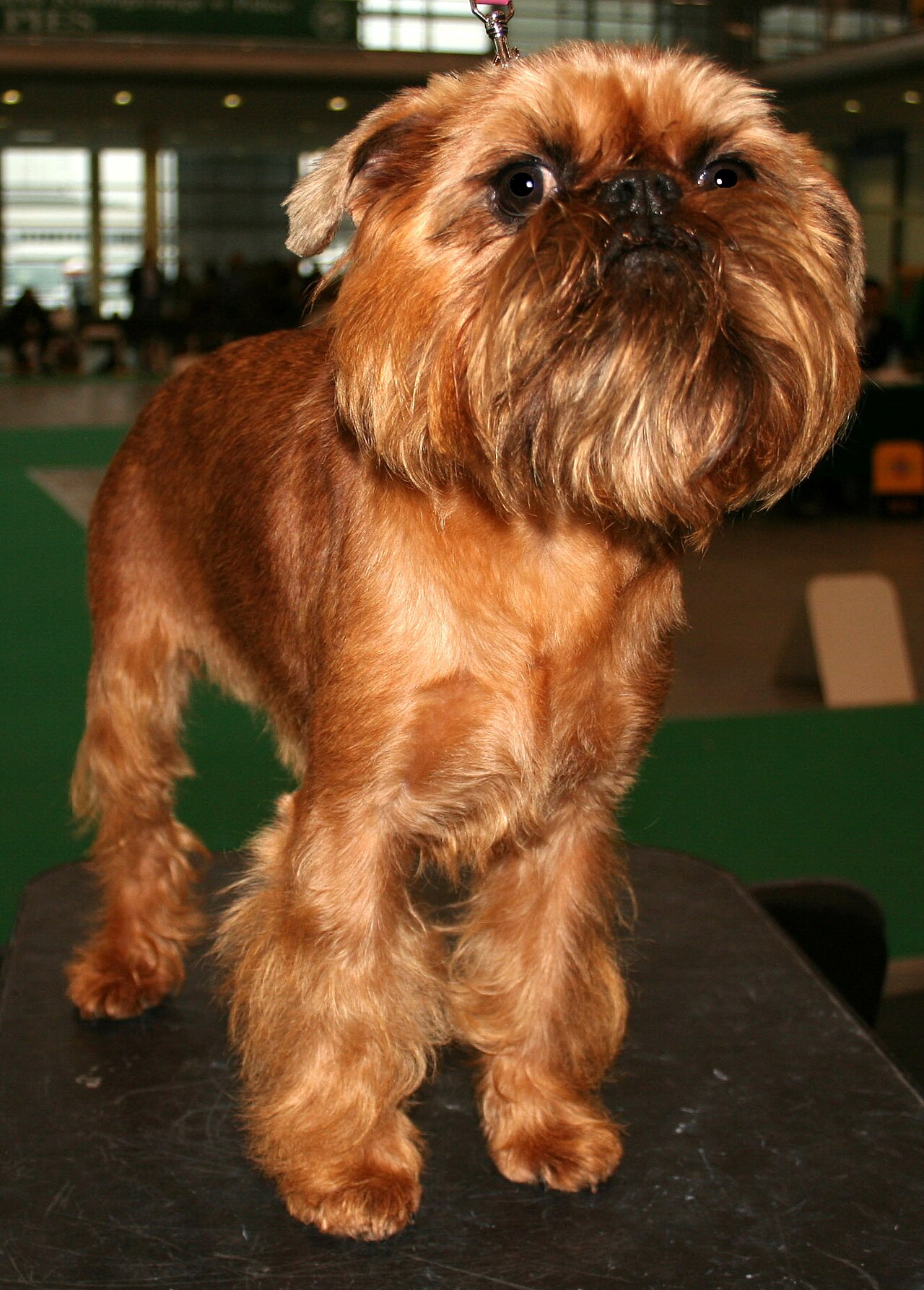
A small, square, thickset dog with good bone, a short back and a large, round head that the FCI calls "the most characteristic part of the body". The nose is black and set between the eyes, the stop is very deep, and the jaw is undershot with a broad, upturned chin. The FCI limits the foreface, including the nose, to 1.5 cm. The large, dark eyes give the breed its famous "almost human" expression. Rough-coated dogs wear a beard and moustache.
| Males | Females | |
|---|---|---|
| Height | 7-10 in | 7-10 in |
| Weight | 8-10 lbs (AKC: no more than 12 lbs) | 8-10 lbs |
| Lifespan | 12-15 years | 12-15 years |
| Coat | Rough (wiry, dense) or smooth (short, tight, glossy) | Same |
Height, weight and lifespan are from the AKC; neither the AKC nor the FCI standard sets a height. The FCI allows 3.5 to 6 kg (about 8 to 13 lbs). The ABGA says adults usually weigh 6 to 12 lbs. The rough coat must be harsh and wiry; a silky or woolly coat is a fault under both standards.
Exercise and daily life
The AKC recommends at least half an hour of moderate exercise a day. Griffs love to romp, chase a ball and come along on errands, and the ABGA says they are as comfortable with a hike or a romp in the snow as with a snuggle on the sofa. Many compete in obedience, agility, rally and tracking.
An apartment suits the breed well, as long as someone is home much of the day. Heat is the real limit. The AKC warns that, like all flat-faced breeds, Griffs "can experience breathing problems in sunny, hot, or humid weather". Walk early and late in summer, carry water, keep the dog out of hot cars and use a harness rather than a collar.
Training
The AKC calls Griffs highly intelligent and "easy to train" because they bond so strongly, but warns that "they don't respond well to harsh corrections". Short sessions with food rewards work best.
Typical difficulties:
- Housetraining. The AKC says it "may take some extra time and effort", as with many toy breeds. Use a fixed routine, take the puppy out often and consider an indoor potty spot for bad weather.
- Being alone. Teach short absences from the first week and build up slowly. A Griff that is left alone for long days can become unhappy and noisy.
- Barking. Thank it once for the alert, then call it away and reward quiet.
- Wariness of strangers. Introduce the puppy to many calm, friendly people, children and dogs, without letting anyone grab or carry it around.
Grooming
It depends on the coat. The AKC says the smooth Griff needs weekly brushing, daily during its short spring and fall sheds, and an occasional bath. The rough Griff barely sheds, but its coat must be groomed: show dogs are hand-stripped, and the AKC standard penalizes coats shaped with scissors or clippers. Many pet owners have the body clipped short and leave the beard, which is easier but softens the wiry texture and color.
Wipe the beard after meals, check the facial folds and the large eyes daily, brush the teeth often and keep the nails short. Rough Griffs are not hypoallergenic despite the low shedding.
Health
The AKC calls Griffs "generally healthy dogs", but the breed's flat face and small size bring known risks:
- Breathing (BOAS). The short airway can cause noisy breathing, snoring and heat intolerance. Watch for loud breathing at rest or a dog that tires quickly.
- Syringomyelia and Chiari-like malformation. The skull can be too small for the brain, which blocks the flow of spinal fluid and forms cavities in the spinal cord. In a US study of 84 AKC-registered Griffs, 65% had Chiari-like malformation and 52% syringomyelia on MRI, and about half of the dogs with syringomyelia showed no signs. Neck pain, scratching at the shoulder or air, and sensitivity when touched are warning signs.
- Eyes. The large, exposed eyes injure easily; the AKC also names cataracts.
- Patellar luxation (slipping kneecaps) and hip dysplasia.
- Heart problems, which the AKC lists among conditions breeders screen for.
- Difficult births. In the UK Kennel Club's 2004 health survey, 39% of the 82 reported Griffon Bruxellois litters were born by caesarean section.
The ABGA code of ethics recommends that every sire and dam be screened for hereditary eye defects and patellar luxation before breeding, and encourages extra tests such as hips and thyroid. The AKC lists patella, hip and eye exams as the parent club's recommended tests. Some breeders also scan for syringomyelia by MRI.
Cost
The ABGA does not publish prices, and a puppy from a health-tested litter may mean a wait. Plan on roughly $1,500 to $3,500 for a puppy from a breeder who health-tests. Start with the ABGA breeder referral and the AKC Marketplace, and look at National Brussels Griffon Rescue if an adult dog suits you.
Running costs are moderate for a dog this size: roughly $800 to $1,500 a year for food, routine vet care, preventives and insurance. Add hand-stripping or regular clipping for a rough coat, and keep a reserve for vet bills: eye injuries, a knee operation or an MRI can each cost more than a year's routine care.
Who it suits and who it does not
Good match for:
- Adults, couples and seniors who are home much of the day and want a devoted, funny companion
- Apartment dwellers in a mild climate
- People who enjoy training tricks or small-dog sports
- Owners ready to learn hand-stripping or to pay a groomer who knows it
Not a match for:
- Families with toddlers or boisterous young children
- People who work long days away from home
- Homes in hot, humid climates without air conditioning
- Anyone who wants a dog without the risks of a short face. For a robust little terrier with a normal nose, look at the Norfolk Terrier; for a cheerful toy that loves to learn, the Papillon. The closest look-alike in spirit and beard is the Affenpinscher, though its face is short too