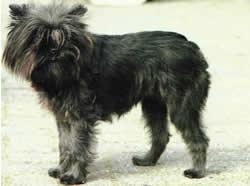
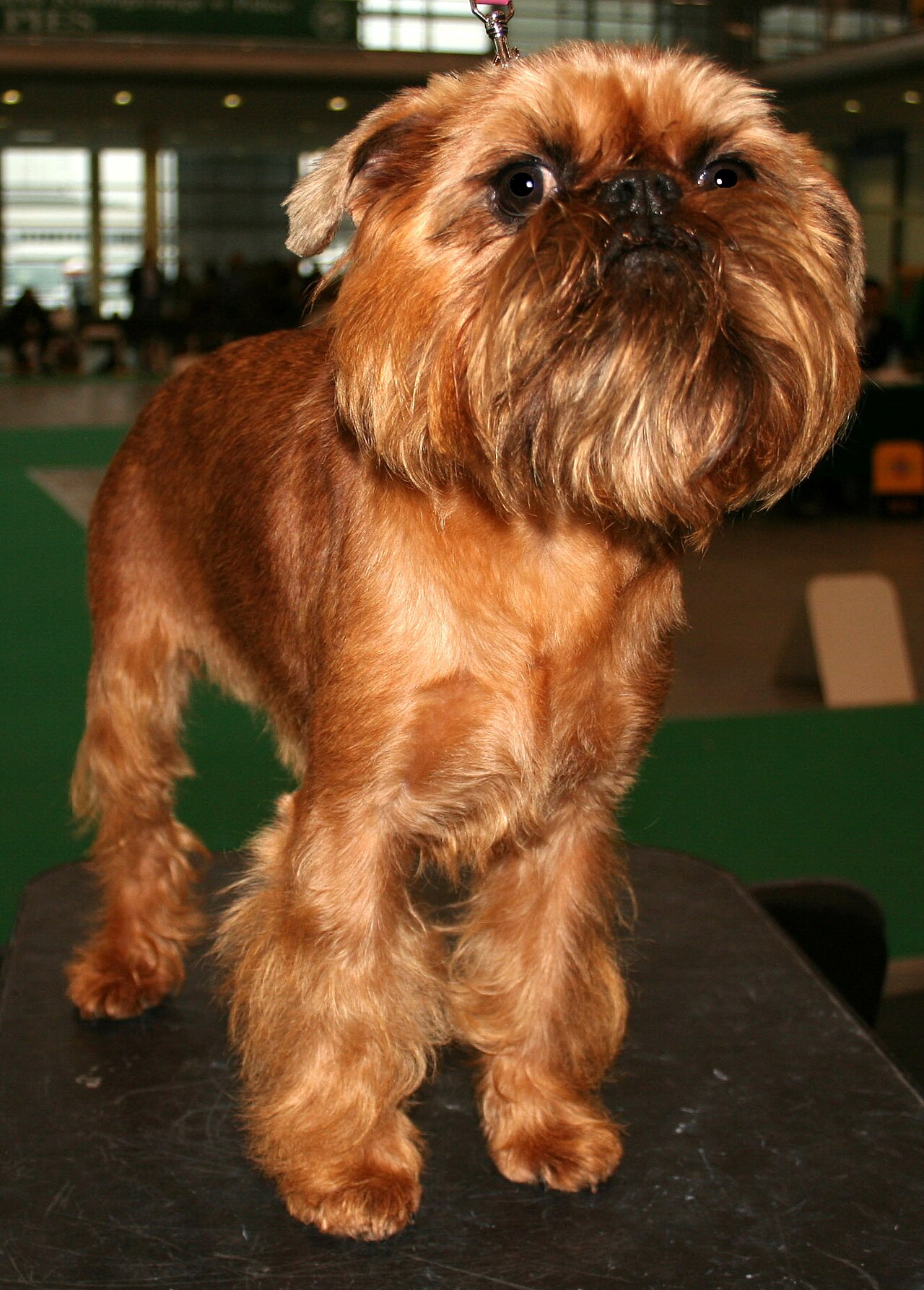
On our ratings the two differ in one point only: the Affenpinscher sheds less and is on the AKC's list of hypoallergenic breeds. Everything else is close, because these are two bearded toy dogs that started with the same job, keeping stables free of rats. The case for the Brussels Griffon is its devotion and, if you want an easy coat, its smooth variety.
- Origin. The Affenpinscher is German: small rough-coated pinschers hunted rats in 17th-century stables and kitchens, and the German name means "monkey pinscher". The Griffon comes from the stable dogs of Brussels coachmen, which looked much like Affenpinschers; crosses with the Pug and the Ruby King Charles Spaniel in the 19th century brought in the short black coat and fixed today's type. The FCI files them in different groups: the Affenpinscher with the pinschers and schnauzers (Group 2), the Griffon with the companion dogs (Group 9).
- One breed or three. The AKC registers one Brussels Griffon in a rough and a smooth coat. The FCI splits it into three breeds: the Griffon Bruxellois (red, rough coat), the Griffon Belge (black or black and tan, rough coat) and the Petit Brabançon (smooth coat). The Affenpinscher is one breed everywhere, but the accepted colors differ: the FCI allows only black, the AKC also gray, silver, red, belge, and black and tan.
- How to tell them apart. The Affenpinscher has a shaggy, tousled head with hair standing out around the eyes and beard, which gives it its monkey face. The Griffon's head is large and round, with big, wide-set eyes and an almost human expression, and its face is flatter: the FCI allows it a muzzle of at most 1.5 cm, nose included. That flat face brings breathing trouble in hot weather and a high rate of syringomyelia (see Health). The Affenpinscher's muzzle is short too, so neither is free of short-face risks; in the Affenpinscher they are less extreme.
- Coat and allergies. The Affenpinscher and the rough Griffon both have a harsh coat that sheds little and keeps its texture best when hand-stripped. The smooth Griffon needs only weekly brushing but sheds more, which is why our Griffon shedding rating, covering both coats, is a point higher. No dog is free of allergens, so if someone in the house is allergic, spend time with an adult dog of the breed before you buy.
- Character. The AKC calls the Affenpinscher "famously amusing" and "fearless out of all proportion to his size": a terrier in a toy body that will take on far bigger dogs. The Griffon is a "Velcro" dog, sensitive and attached to its person, and copes badly with long days alone. Neither is a playmate for toddlers: we rate both 2 out of 5 with young children.
- Health. In a US study of 84 AKC-registered Griffons, 65% had Chiari-like malformation and 52% syringomyelia on MRI; ask whether the parents were scanned. For either breed, ask for the parents' kneecap and eye results, and for a Griffon also the hips.
- Price. The Affenpinscher is the cheaper puppy: about $1,000-$2,500, against $1,500-$3,500 for a Griffon.
Pick the Affenpinscher if allergies or shedding matter or you want a bold, independent little dog; pick the Brussels Griffon if you want a devoted companion that stays at your side, and consider the smooth coat if you would rather brush than hand-strip.