Origin and history
The White Swiss Shepherd is, in effect, the white German Shepherd brought back as a breed of its own. White puppies have always turned up in German Shepherd litters, but the color fell out of favor, and the AKC's German Shepherd standard still states that "a white dog must be disqualified." Breeders in the US and Canada kept the white dogs anyway.
According to the FCI standard, the first of them reached Switzerland in the early 1970s, and an American male named Lobo, whelped on March 5, 1966, counts as the founding sire there. From June 1991 the Swiss Kennel Club (SKG) registered his descendants and later imports as a new breed. The FCI accepted it provisionally on November 26, 2002, and recognized it definitively on July 4, 2011, as the Berger Blanc Suisse, standard No. 347, group 1, with its use listed as "companion and family dog."
What this means in the US. The AKC does not recognize the breed. The United Kennel Club recognizes a different one, the White Shepherd (since 1999), which also descends from white German Shepherds but developed separately in North America. The UKC standard sets an ideal of 25 in and 75-85 lbs for males and accepts a very light cream shade; the FCI breed must be pure white. In daily life the two are very similar, but they are separate registries and gene pools. Fans of the FCI breed have their own club, the White Swiss Shepherd Club of America (WSSCA), founded in 2014, which keeps its own studbook and health database.
White Swiss Shepherd vs white German Shepherd. A white German Shepherd is a German Shepherd of a disqualifying color: the AKC registers the breed but bars white dogs from the show ring. The White Swiss Shepherd is a separate FCI breed with its own studbook, registered in Switzerland since 1991. Its standard asks for a level, firm back and treats a steeply sloping topline as a serious fault.
Temperament and character
The FCI standard describes a lively, balanced dog that "enjoys action," is attentive, friendly and discreet, devoted to its owner, and never afraid or aggressive without provocation. In daily life:
- It is softer than its cousin. Purina's breed profile calls it friendlier to strangers than the German Shepherd.
- It still has a voice. Purina notes it is vocal and will bark and guard if it feels it must.
- It bonds deeply. It can become a one-person dog and wants to be wherever you are. It is not a backyard dog.
- It is sensitive. Purina warns that aversive methods "will produce a confused and unhappy dog."
With children it is usually gentle. Purina still prefers a quiet home with older kids: the dog is clumsy around toddlers and "would not cope well with a constant traffic of children's friends."
Size and appearance
A powerful, moderately long shepherd with erect ears and a pure white double coat, either medium length or long with a mane and trousers. Nose, lips and eye rims should be dark.
| Males | Females | |
|---|---|---|
| Height | 23-26 in (58-66 cm) | 21-24 in (53-61 cm) |
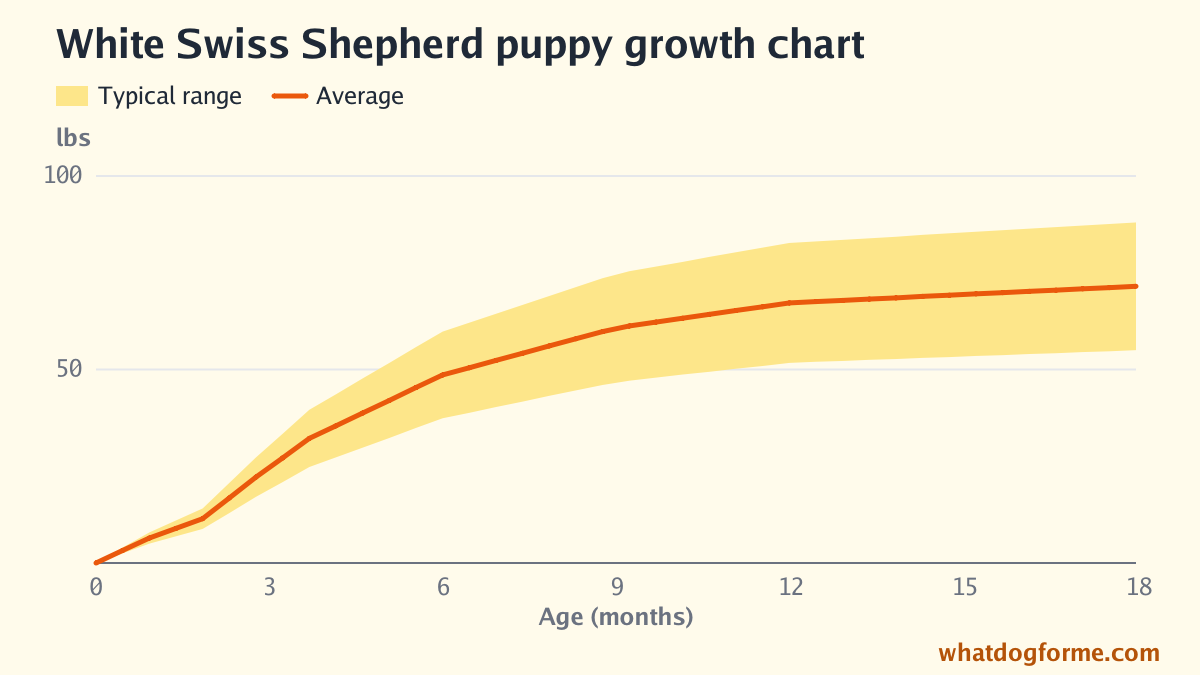
| Weight | 66-88 lbs (30-40 kg) | 55-77 lbs (25-35 kg) |
| Lifespan | 12-14 years | 12-14 years |
| Coat | Dense double coat, medium or long | Same |
Height and weight are from the FCI standard. Purina gives a shorter lifespan of 10-12 years.
Exercise and daily life
Purina recommends about two hours of exercise a day, plus time for training and mental work. Hiking, jogging with an adult dog, nosework, obedience and agility all suit this tireless trotter. With puppies, go easy on stairs, steep hills and jumping.
A house with a securely fenced yard in a suburban or rural area fits best; Purina warns that inner-city life can turn it into a stressed, barking dog. It wants to live indoors with its people.
Training
It learns quickly and likes working with you. What works: early, broad socialization, rewards, short varied sessions and calm consistency. Purina describes the breed as slow to mature, so expect a long adolescence.
Typical difficulties:
- Stress when left alone, if independence was never practiced.
- Barking at the door and along the fence when nobody sets limits.
- Shyness in poorly socialized dogs. The FCI standard treats anxious or overly shy dogs as a disqualifying fault, so ask how the breeder raises litters.
Grooming
Easier than the color suggests. The Dutch breed club calls the coat largely self-cleaning: dried mud brushes out, so baths are rarely needed. Purina recommends brushing weekly for the medium coat and twice a week for the long coat. The catch is shedding, which Purina describes as "incredible amounts of fur," peaking during the twice-yearly coat change.
Health
Conditions to know by name:
- Elbow dysplasia. The weak point in the US. In the WSSCA's summary of cumulative OFA results up to the end of 2024, about 17% of 259 elbow ratings were abnormal, and the club says the breed ranks poorly among OFA breeds.
- Hip dysplasia. In the same data, about 13% of 256 dogs had dysplastic hips.
- MDR1 drug sensitivity. A mutation that makes ivermectin-type drugs and some other medicines dangerous. A German study of 7,378 dogs found an allele frequency of 14% in the breed; in the US data up to 2024, 8 of 99 dogs tested were carriers.
- Degenerative myelopathy (DM). A progressive spinal disease of older dogs linked to a SOD1 variant. In the US data up to 2024, 23 of 131 dogs tested were carriers.
- Heart defects. The WSSCA reports aortic, subaortic and pulmonic stenosis missed by stethoscope and found only by echocardiogram.
- Also reported: allergies, panosteitis in growing dogs, megaesophagus and epilepsy.
Ask for these results for both parents: OFA or PennHIP hips, OFA elbows, MDR1 and DM DNA tests, an eye exam (CAER) and a cardiac exam, ideally an echocardiogram. These match the WSSCA's recommended tests.
Cost
US breeders of FCI-registered litters are few and typically ask $3,000 to $4,500 for a puppy. In October 2026 the listing site K9Stud reported a median asking price of $3,500, Wildwood Kennels listed a total price of $4,500, and Moro Shepherds in Oregon asked $6,000 on Good Dog ($1,200 deposit plus $4,800 before pickup), so top breeders can go well above the usual range. In Europe a health-tested puppy from a club breeder costs about €1,400 to €2,500, but importing is not a shortcut: since August 2024, CDC rules require imported dogs to be at least 6 months old, so a European puppy arrives as an adolescent. Cheap "white German Shepherd" ads without health results are a red flag.
Running costs are roughly $1,200 to $2,000 a year for food, routine vet care, preventives and supplies, with insurance and classes on top.
Who it suits and who it does not
Good match for:
- Active families with older children who want a loyal, trainable dog
- Homes with a fenced yard in a suburban or rural setting
- People who enjoy training and dog sports
- Owners who want a watchful dog without a hard guarding temperament
Not a match for:
- Small city apartments and owners who are rarely home
- Anyone who hates dog hair on floors and clothes
- People looking for a protection dog or a high-level competition dog
- Homes with toddlers and a constant stream of visiting kids
For protection work or high-level competition, look at the Belgian Malinois or Dutch Shepherd (for experienced handlers). For a self-reliant property guardian, the Hovawart is a better fit.