Origin and history
The Eurasier was designed from the start as a family companion, not a working dog. In 1960 Julius Wipfel of Weinheim, Germany, bred a Chow Chow male to a Wolfspitz female (the breed the AKC registers as the Keeshond). He wanted an easy-going Spitz that kept the social behavior of its wolf-like ancestors. The result was first called the "Wolf-Chow." In 1972 a Samoyed male was crossed in to widen the narrow gene pool, and in 1973 the breed was renamed "Eurasier" and recognized by the FCI and the German kennel club VDH.
Today it is FCI standard No. 291, group 5 (Spitz and primitive types). In the US it has been in the AKC Foundation Stock Service since 2008, and in 2024 the AKC named the United States Eurasier Club (USEC) its parent club. The USEC counts fewer than 20 breeders in North America.
Temperament and character
The FCI standard calls the Eurasier self-assured, calm and even-tempered, watchful without being noisy, with a very strong bond to its family. In daily life:
- It is reserved with strangers. The USEC warns that if you want a dog that loves everyone it meets, this is not the breed. Most Eurasiers will not let a new person touch them right away. That is caution, not fear or aggression.
- It bonds with the whole family, not one person. It wants to be in the same room as you.
- It is a watchdog, not a guard dog. It announces unusual noises with a short bark or a low growl, then stops.
- It gets along with children and other pets. Socialized early, most accept children, other dogs and cats.
The weak point is time alone. The German breed club EKW advises that a Eurasier should not be left for more than four hours, and Purina's profile says it won't tolerate being left alone.
Size and appearance
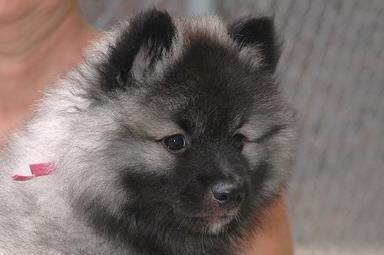
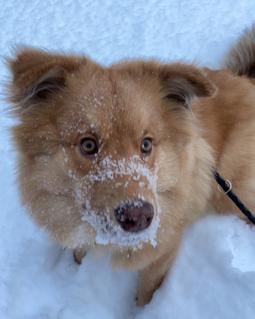
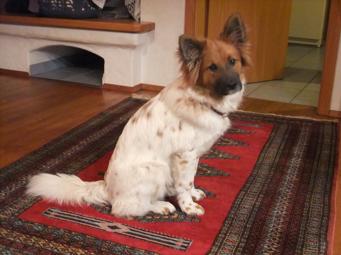
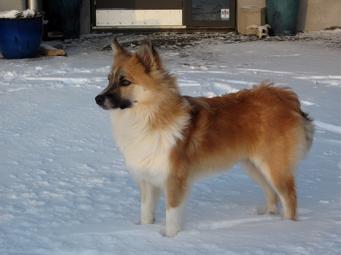
A medium-sized, well-balanced Spitz with prick ears, a wedge-shaped head and a bushy tail carried over the back. All colors are allowed except pure white and piebald, so you see fawn, red, wolf-gray, black, and black-and-tan.
| Males | Females | |
|---|---|---|
| Height | 20.5-23.5 in (52-60 cm) | 19-22 in (48-56 cm) |
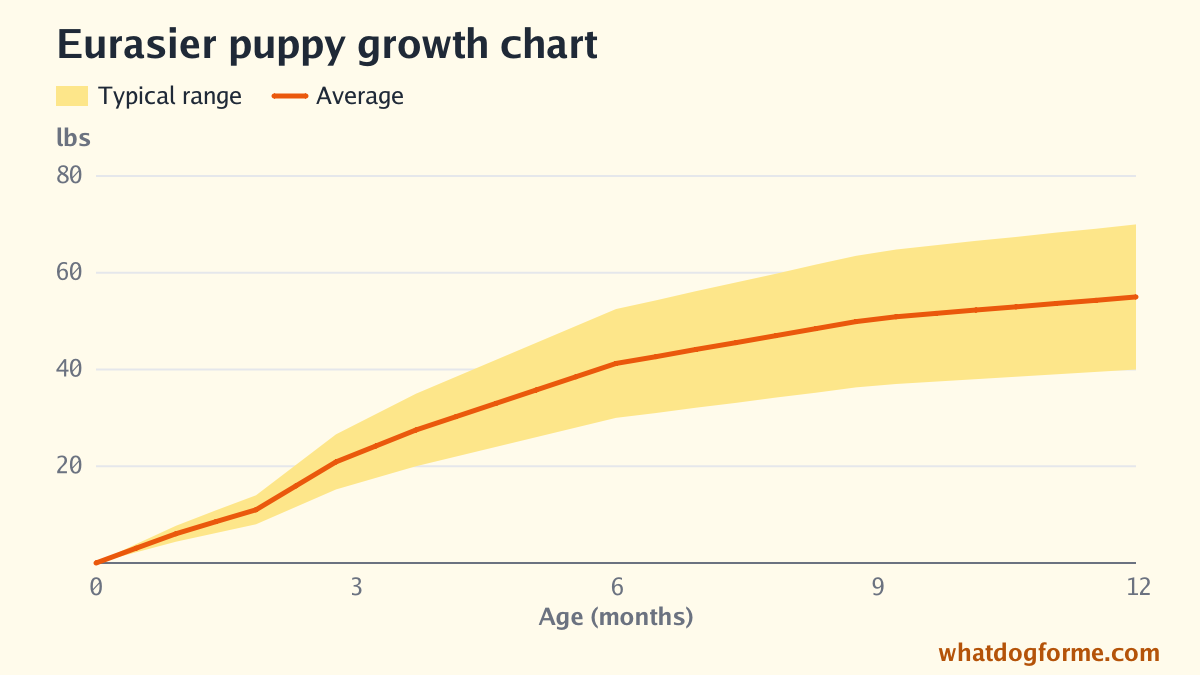
| Weight | 48-66 lbs (22-30 kg) | 40-57 lbs (18-26 kg) |
| Lifespan | 12-14 years | 12-14 years |
| Coat | Thick undercoat, medium-long straight guard hair | Same |
Height and weight are from the current FCI standard (2019); lifespan is the USEC figure.
Thanks to the Chow Chow, the tongue can be fully blue-black, pink, or anything spotted in between. The EKW notes that tongue color does not matter as a breed trait.
Exercise and daily life
This is a moderate-energy dog. The EKW recommends one to two hours of walking a day, and the USEC says daily walks with some off-leash time meet the needs of most Eurasiers. Many enjoy hiking or agility once grown; few care much for fetch.
The breed adapts to a house, a farm or a roomy apartment, as long as it lives indoors with its people.
Heat is a real limit. Purina's profile notes that the Eurasier is not built to exercise in the heat. In summer, walk at dawn and after dark and skip hard exercise on hot afternoons.
Training
The Eurasier learns quickly but is sensitive and shuts down under harsh corrections. Positive reinforcement, short varied sessions and a calm, consistent handler work best.
Typical difficulties:
- Reserve that turns into avoidance in a puppy that meets too few friendly strangers.
- Boredom with drills. Stop while the dog is still keen, and vary the exercises.
- Separation stress if the puppy never learns that being alone for a short while is normal.
Grooming
The German and French breed clubs say weekly brushing is enough for most of the year. Twice a year, during spring and fall shedding, the undercoat comes out in clumps, and daily brushing helps it along. Check behind the ears, where the hair is soft and mats first. Baths are rarely needed; if you give one, dry the coat thoroughly to avoid hot spots.
Health
The USEC calls the Eurasier a relatively healthy breed, but its small founding population left a few known problems:
- Autoimmune thyroiditis and hypothyroidism. The most common issue. According to 2020 OFA data cited by the USEC, 14.4% of Eurasier thyroid panels were abnormal. A 2023 study of 1,501 Eurasiers from a German club found that 3.9% were already hypothyroid at their first screening (median age 18 months), and 42.5% of dogs with thyroglobulin autoantibodies (TgAA) became hypothyroid later. Treatment is a daily tablet.
- Patellar luxation. 7.6% abnormal in OFA records, the most common orthopedic finding.
- Hip and elbow dysplasia. 3.2% and 5.2% abnormal in OFA records.
- Dandy-Walker-like malformation (DWLM). A hereditary brain malformation that causes non-progressive wobbliness from puppyhood. A 2015 study found the responsible VLDLR gene variant and 16% carriers among 96 Eurasiers.
- Eyelid and lash problems: entropion, ectropion and distichiasis.
- Inherited hypercholesterolemia. A recessive disorder now under study at the Universities of Minnesota and Bern. Without treatment, affected dogs often die before two years of age.
Ask for these results for both parents: OFA or PennHIP hips, elbows, patellas, an eye exam, a full thyroid panel with TgAA from the past year (the USEC requires this before breeding), and a DWLM DNA test. The breed is in the OFA CHIC program, so you can check the parents online.
Cost
Rarity shows in the price: expect $2,000 to $5,000. The Puppybase price guide puts the average US price around $2,500, while two breeders Petful checked in October 2026 asked $4,000 and $5,000. Waiting lists are normal. Importing is an option: the German EKW charges €2,200 per puppy, plus flights and fees. Running costs are roughly $1,500 to $2,500 a year for food, vet care, preventives, insurance and classes. Lifelong thyroid medication, if needed, comes on top.
Who it suits and who it does not
Good match for:
- Families who are home a lot and want a calm, close companion
- First-time owners willing to socialize carefully and train gently
- Homes with children who respect a dog that sometimes wants its space
- People who prefer a quiet watchdog to a barker
Not a match for:
- Households where the dog would be alone for eight hours a day
- Anyone who wants a dog that greets every stranger like a friend
- Hot climates without air conditioning or shade
- Owners who want a dog that lives outdoors or in a kennel